Lead Source Tracking: Why Your Channel Report Doesn't Match What Sales Sees
It's the last leadership meeting of the quarter. You put up the channel slide: the spring trade show and the partner programme look thin, and a large slice of open pipeline sits under no source at all. The head of sales disagrees: those deals came from the booth and from partner introductions, and the sales team can name them. Next quarter's event and partner budget is on the table, and so, quite possibly, are both teams' bonuses. Whichever version leadership believes will decide where the money goes.
Nobody in that room is being careless. Marketing reports what Salesforce holds; sales reports what sellers remember. The gap usually lives in one field on a handful of records, and you can trace it before the quarter closes.
What lead source tracking is
Lead source tracking means recording where each lead and each deal came from, so spending can follow results. In Salesforce, Lead Source is a standard picklist on leads, contacts and opportunities, and most channel reports group pipeline by it. Many teams also separate the original source (how the buyer first arrived) from the latest source (what brought them back); this article deals with the single value most leadership reports read.
Why your channel report and sales disagree
Any CRM lead source field is only as reliable as the way it gets filled in. In Salesforce, the disagreement usually comes from a few ordinary causes:
- Deals sellers create directly start with no source. When a lead converts, Salesforce copies its Lead Source to the new opportunity, as the Lead Conversion Field Mapping reference shows. An opportunity a seller opens from an account after a meeting has no lead behind it, so the field stays blank unless someone fills it in. Lucy Mazalon describes this pattern in her Salesforce Ben overview of Lead Source.
- Catch-all values swallow real channels. "Other" and "Web" are easy to pick and hard to act on. Sometimes the picklist has no value for the channel at all. In the Salesforce org used for this article, the active Lead Source values were Web, Phone Inquiry, Partner Referral, Purchased List and Other. Trade Show had been deactivated and no webinar value existed, so a booth conversation could only be recorded as Other or left blank until someone added them.
- Whoever fills in the field shapes the answer. RevOps writer Jeff Ignacio explains why sales and marketing bring different "sourced pipeline" numbers to the same review: when both teams are paid on sourced pipeline, whoever updates the field first tends to win. Fractional CMO Marcus Hermens notes a quieter version: reps record whatever source seems closest, and nobody audits it.
- A sync can overwrite the original value. Mazalon also notes that a marketing automation sync can replace an earlier Lead Source if the system of record isn't set carefully. If your values change after a sync, start with how HubSpot and Salesforce sync errors show up.
- One value can't hold the whole story. A single source per deal hides other channels that helped, and software may not see where the buyer heard about you. Refine Labs CEO Megan Bowen compared a year of her company's software-recorded sources with buyers' own answers across 620 conversions, and the two pointed to very different channels. Her data came from HubSpot, but the blind spot is the same.
What the report looks like when the source is missing
Here is next quarter's open pipeline for Fernhill Labware, a company selling lab inventory and sample-tracking software to research labs and biotech companies, grouped by Lead Source.
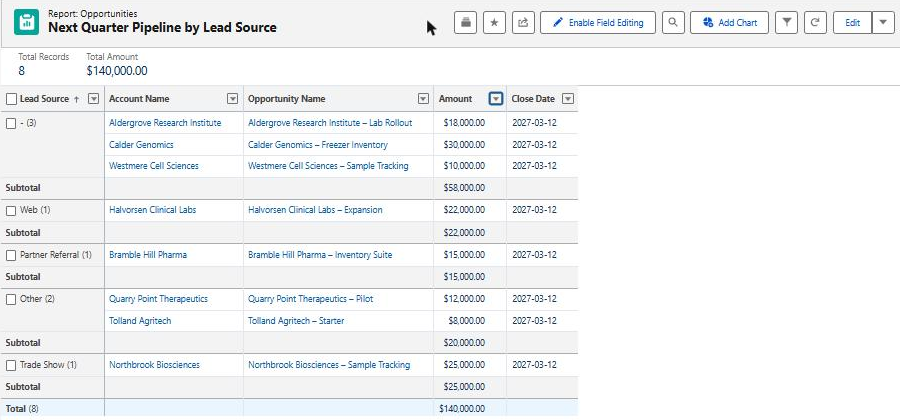
Before: next quarter's open pipeline grouped by Lead Source. Three deals worth $58,000 have no source, and two more sit under Other.
Three opportunities worth $58,000 have no source: over 40% of the $140,000 in open pipeline. Add the $20,000 under Other and more than half the pipeline has no channel leadership can act on. The trade show shows one deal at $25,000; partners show one at $15,000. That is the view leadership is being asked to fund events and partners against.
Only one of these deals came through a converted lead: Northbrook Biosciences, whose trade show source carried over at conversion. Sellers opened the other seven directly, and that is where the blanks are.
Check the evidence before changing anything
The obvious fix is to ask sales where each deal came from and update the field. That conversation is useful, but it shouldn't be the evidence. Correct a source only where the record shows where the deal came from. A guessed source is worse than a blank one, because it looks trustworthy.
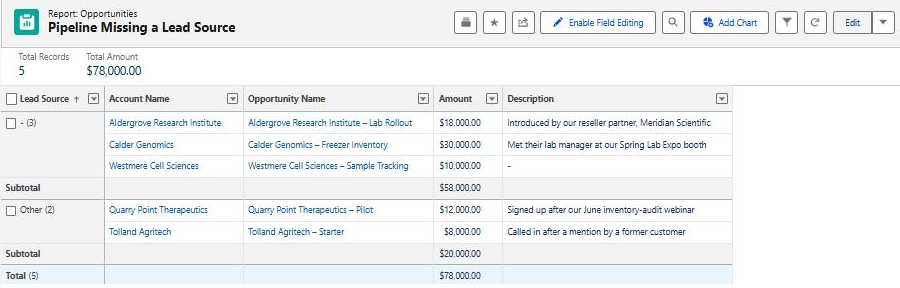
The review list: only opportunities with no source or Other, with the seller's note beside each. Three notes name a channel; one record has no note.
In this example, each opportunity's Description holds the seller's note. Three records carry clear evidence:
- Calder Genomics met the team at the Spring Lab Expo booth, so it moves to Trade Show.
- Aldergrove Research Institute was introduced by reseller partner Meridian Scientific, so it moves to Partner Referral.
- Quarry Point Therapeutics signed up after the June inventory-audit webinar, so it moves to Webinar.
Tolland Agritech called in after a former customer mentioned the company, so Other is an honest answer. Westmere Cell Sciences has no note at all, so it stays blank and visible. Someone may know where it came from; until they write it down, the report should say "unknown."
In your org, the evidence may sit in activity history, campaign membership or the original lead instead. If deals lose their history at conversion, see what Salesforce lead conversion can leave behind.
Same pipeline, a different budget conversation
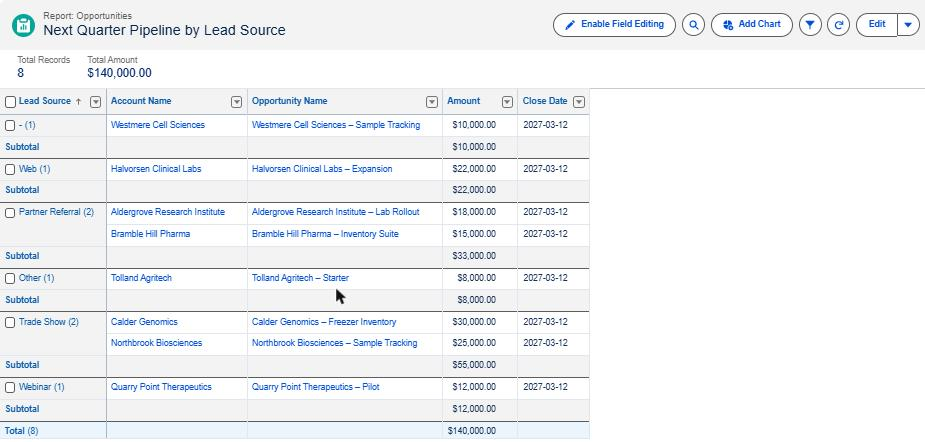
After: the same report, filters and columns. Total pipeline is still $140,000; trade show and partner pipeline grew because three records now show where they came from.
No deal changed. The same eight opportunities still total $140,000. But the trade show now carries $55,000 instead of $25,000, partner referrals $33,000 instead of $15,000, and the webinar appears with $12,000. Pipeline with no source fell from $58,000 to $10,000.
That's a different budget conversation. It doesn't prove the trade show was a good investment: open pipeline isn't closed revenue, and one source per deal still simplifies the buyer's path. It does mean leadership can argue about channels rather than about the data.
Settle the dispute before the next review
The corrections fix this quarter's slide; the dispute returns unless marketing and sales agree on the rules. These are suggested practices, not tested results.
- Write down what each source means and who sets it. "Trade Show" should mean the first conversation happened at the booth, not that an existing prospect stopped by. Decide who sets the value and when it may change. Tom Keefe, formerly head of marketing operations at Demandbase, describes how "who sourced this deal?" arguments climb to the CMO and the chief sales officer; a written definition gives that conversation somewhere to start.
- Separate credit for compensation from the view used to judge channels. Ignacio suggests keeping source for compensation while judging channels on influence and win rates, with a threshold both teams agree on in advance. Asking one field to answer both questions puts pressure on it.
- Add a self-reported cross-check. A "how did you hear about us" question won't settle every case, but where it disagrees with Lead Source you have a deal worth a closer look.
If the handoff itself is unclear, the marketing-to-sales handoff questions a CEO is likely to ask are a useful companion, and lead assignment rules decide who owns a lead in the first place.
Keep it from drifting
Small, proportionate controls usually beat a large attribution project:
- Ask for a source when sellers create opportunities. A required field closes the most common gap. The tradeoff: a required field nobody can answer well becomes another field people type around, so agree the definitions first or deals will simply move from blank to Other.
- Trim and fill the picklist. Retire values nobody uses and add the ones your budget decisions depend on. As Mazalon puts it, "Don't go crazy with the number of Lead Source picklist values."
- Review blank and Other every month. A review list like the one above shows exactly which deals need attention.
- Name an owner. Usually a marketing operations lead or Salesforce administrator, with sales leadership agreeing to the definitions. Duplicate records split a buyer's history too; see duplicate management and wider Salesforce data quality.
Bring one disputed deal
Bring the channel report leadership questioned and one deal sales says was miscredited. Contact Logic Conduit to trace where that deal's source was set, changed or lost in Salesforce, and what it would take to make the report trustworthy before the next budget decision. If the value is being overwritten or dropped as records move between a marketing platform such as HubSpot, Marketo or Account Engagement and Salesforce, the Salesforce Integration Sprint covers one bounded integration, including data mappings and reconciliation checks.