Marketing to Sales Handoff: 5 Questions Your CEO Will Ask, and Where Salesforce Keeps the Answer
The campaign slides are ready. Registrations were strong and attendance beat the last webinar. Then the CEO asks the questions that matter in the room: why isn't revenue moving? Sales says the leads were weak, so which is it? And what exactly do you want me to fund next quarter?
Those questions are really about what happened after marketing passed the leads to sales, and whether anyone can show it. If your company runs sales in Salesforce, most of the answer should already be there. The useful check before the meeting is whether your records can tell that story, and if not, which gap to close first.
What the marketing to sales handoff means in Salesforce
The marketing to sales handoff is the point where a lead that marketing generated becomes sales' responsibility to work. In Salesforce it leaves a trail: the lead's owner and status, its campaign membership, whether it was converted, and the opportunity it became. When that trail is complete, the leadership conversation moves from opinion to evidence. When pieces are missing, both teams end up defending their own numbers.
To make this concrete, take Larkspur Dispatch, which sells dispatch and routing software to regional freight carriers. Its marketing team ran a Q3 Route Planning Webinar, and twelve attendees came in as leads on the campaign. Separately, the sales team has five open opportunities worth $99,000 closing next quarter. Here is how each of the CEO's five questions maps to that data.
1. How many leads did marketing hand to sales, and what happened to them?
Start with a shared fact: Lead Status. Arguing about whether leads were "good" goes nowhere when nobody can say how many were contacted. A report of the campaign's leads, grouped by status, gives both teams the same picture.
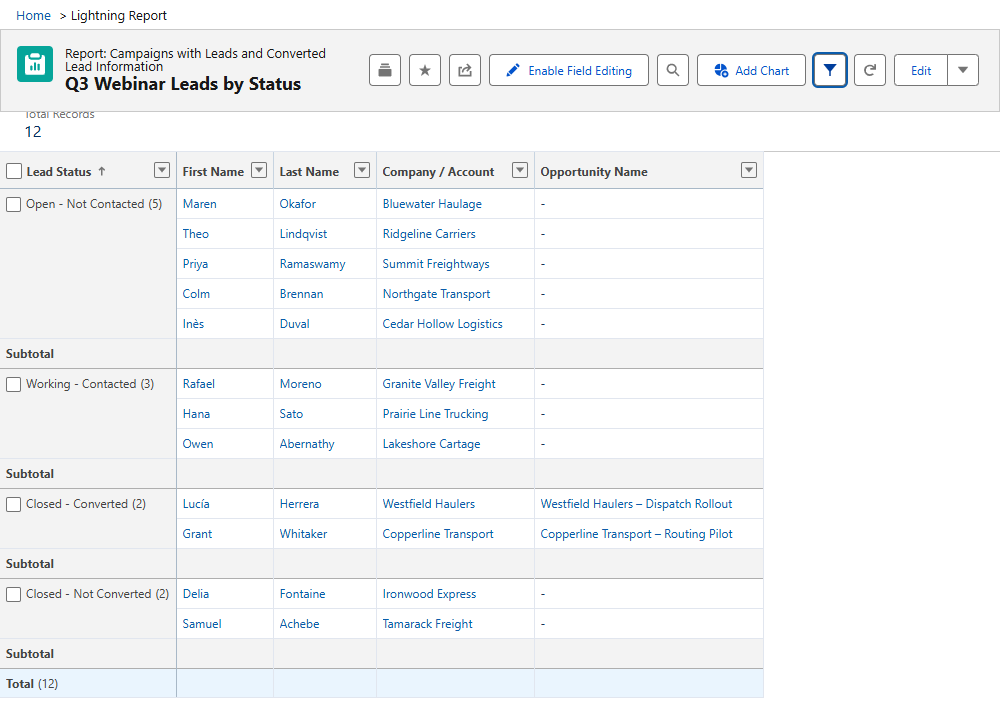
All 12 Q3 Route Planning Webinar leads by Lead Status, including the two that converted to opportunities.
Five of Larkspur's twelve leads haven't been touched yet. That is a follow-up conversation, not a verdict on lead quality, and it is far easier to have with a list of names in front of everyone.
One detail is worth checking in your own org. When we built this view, Salesforce's standard Campaigns with Leads report type listed only 10 of the 12 leads: the two converted leads dropped out. They appeared with the Campaigns with Leads and Converted Lead Information report type. Salesforce's considerations for converting leads note that converted leads do appear in lead reports, but the report type behind a dashboard decides whether marketing's best outcomes are counted.
2. Did sales follow up, and how fast?
This is often the question behind "sales says the leads are bad." SaaStr founder Jason Lemkin wrote that more than 20 sponsors of SaaStr Annual told him lead volume was no longer their problem; follow-up was. As he relayed it: "We can't get our sales team to follow up on the leads this year." (SaaStr on leads that sales doesn't follow up)
The fix is usually an agreement before it is a tool. A simple follow-up expectation, often written as an SLA, sets how quickly sales accepts or works a new lead and asks for a reason when a lead is rejected. Rejection reasons turn "the leads are bad" into specifics marketing can act on, such as the wrong company size. Sellers gain a clear definition of which leads deserve their time.
Measuring speed takes more than the current Lead Status, which only shows where a lead is today. You need a record of when the status changed, from field history or a dated field; the report above does not measure response time. It also helps to confirm that leads reach a clear owner in the first place, which our guide to Salesforce lead assignment rules covers.
3. Which leads became pipeline?
Conversion is where a lead becomes an account, a contact and, when the deal is real, an opportunity. Ashley McAlpin, then VP of Marketing & Sales Development at FormAssembly, put the stakes plainly in her Salesforce Ben piece on rethinking MQLs: "MQL without conversion is useless."
In Larkspur's report, two webinar leads converted: Westfield Haulers and Copperline Transport, now opportunities worth $18,000 and $24,000. The same Salesforce Help page on conversion documents two behaviours that matter here: the lead's campaign membership moves to the new contact, and the opportunity's Primary Campaign Source takes the lead's most recently associated campaign. Both converted opportunities in this example arrived already linked to the webinar.
Conversion can still lose context the seller needs, such as next steps the buyer already agreed to. That is a separate problem, covered in Salesforce lead conversion and repeated discovery.
4. Which campaigns produced pipeline?
Two of Larkspur's five open opportunities came through lead conversion. Two more involve people who attended the webinar but were already contacts at existing accounts, so sellers opened those opportunities directly. The fifth, Stonebridge Logistics, came from a seller's own outreach and has nothing to do with the webinar.
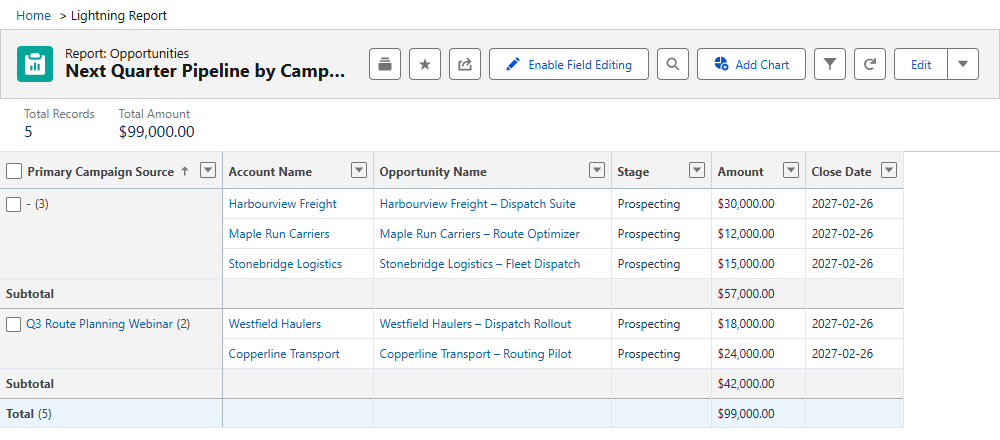
Before: only the two converted opportunities ($42,000) show the webinar as their Primary Campaign Source. Three opportunities ($57,000) have no campaign.
Harbourview Freight and Maple Run Carriers have contacts who attended the webinar and are campaign members. Their opportunities simply had no campaign attached. Setting Primary Campaign Source on those two records, and leaving Stonebridge alone, changes the view:
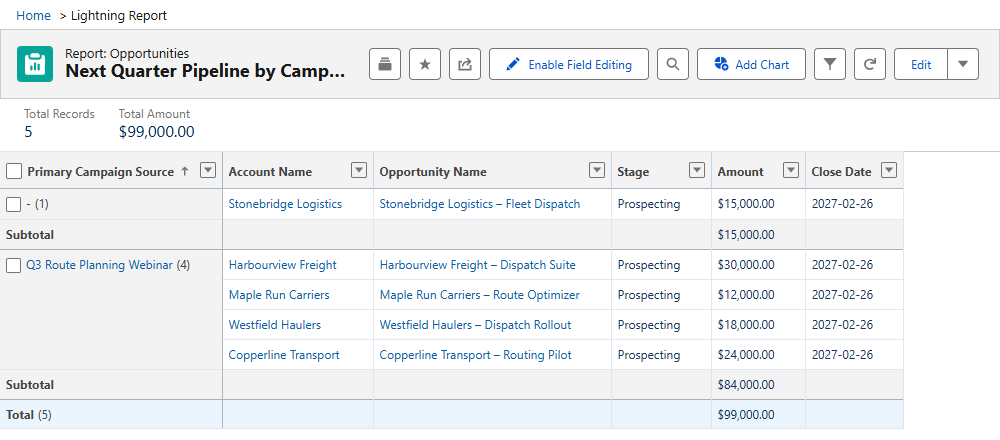
After: the same report, filters and columns. The webinar is linked to four opportunities ($84,000). Stonebridge Logistics ($15,000) stays unlinked. Total pipeline is unchanged at $99,000.
Nothing about the deals changed; the total is $99,000 in both views. What changed is whether the record trail connects the campaign to the deals it supported: without it, the webinar appears to account for $42,000; with it, $84,000.
Two cautions keep this honest. First, this is a reporting check, not an attribution model: Primary Campaign Source gives one campaign the credit for a deal. Second, credit should follow evidence. Harbourview and Maple Run earned the link because their contacts are campaign members who attended. Stonebridge didn't, so it stays blank, even though linking it would make marketing's number bigger. Leadership trusts a number more when it can see the rule behind it.
If your leads start in HubSpot or Marketo and sync into Salesforce, check that campaign membership survives the trip. A sync error can leave records behind without anyone noticing; our guide to fixing HubSpot Salesforce sync errors walks through one example.
5. So what should we fund?
After reviewing board decks and monthly reports from more than 50 companies, B2B marketing agency founder Adam Goyette argued in "You are a marketer: No one trusts you" that CEOs care less about marketing's own metrics than about how marketing affects revenue. Debra Andrews made a related point in Fast Company's "Marketing's reporting is a trust problem": when leadership can't trace that impact, marketing produces more reports, which become "the work about the work." She suggests agreeing on one number leadership already watches, such as pipeline contribution, and reporting it the same way every time.
Salesforce can support that number only if the marketing to sales handoff leaves a trail. When it can answer the first four questions, the budget conversation is about evidence: this webinar produced twelve leads, five still need contact, and $84,000 of next quarter's pipeline involves people who attended. When it can't, fixing the record trail comes before asking for more budget, because any number you present will be questioned. Broader Salesforce data quality problems tend to surface here first.
| CEO question | Where Salesforce keeps the answer |
|---|---|
| How many leads, and what happened to them? | Campaign members by Lead Status, including converted leads |
| Did sales follow up, and how fast? | Lead owner, status and dated status changes |
| Which leads became pipeline? | Converted leads and the opportunities they created |
| Which campaigns produced pipeline? | Primary Campaign Source, backed by campaign membership |
| What should we fund? | The same pipeline-by-campaign view, reported consistently |
Bring one campaign and the question leadership asked about it
You don't need to rebuild your reporting to find out where you stand. Pick one recent campaign and the question your CEO asked about it, then contact Logic Conduit. We'll trace that campaign's leads through Salesforce with you, show which of the five questions your data can answer today, and agree on what to fix first. If the handoff crosses systems, such as a marketing platform syncing into Salesforce, the Salesforce Integration Sprint is designed to connect and test one workflow like that.