Salesforce Win-Loss Analysis: Why Your Closed-Lost Reasons Don't Explain Lost Deals
Picture the quarterly review at a mid-sized software company. Enterprise win rate has fallen two quarters in a row. The Salesforce dashboard is tidy: every Closed Lost opportunity has a loss reason, most have a competitor, and "Price" sits at the top of the chart. The VP of Sales asks the obvious question: "So do we discount, or do we change the product?" Nobody in the room can answer with confidence, because the chart says what sellers selected when they closed each deal. It does not say what buyers actually decided, or why.
That gap is what Salesforce win-loss analysis has to close. Salesforce is good at counting recorded outcomes for a population of opportunities you define. It cannot, on its own, explain why a buyer chose a competitor, stayed with the status quo, or signed with you. Those are two different jobs: a dependable calculation and a credible explanation. A useful review needs both, and it needs them to meet before anyone decides what to change.
This article shows how to settle what your win-rate number measures, test whether your closed-lost reasons explain anything, and turn a small body of evidence into one specific, owned change. It covers wins as well as losses, because understanding why a buyer said yes can be as useful as investigating a no.
What is Salesforce win-loss analysis?
Salesforce win-loss analysis combines consistently recorded opportunity outcomes with evidence about buyers' decisions, so a sales team can decide what to improve. The outcome side answers "how many, and which ones?" The evidence side answers "what happened in the decision?"
A win-rate calculation describes an outcome population. An explanation needs more: notes, call recordings you are permitted to review, buyer interviews or surveys, and a reviewer willing to say "we don't know yet." A complete analysis also gives every type of result a defined treatment, including:
- Closed Won and competitive Closed Lost opportunities.
- No decision, where the buyer kept the status quo or stopped responding.
- Administrative closures, such as duplicates or records closed during cleanup.
- Deals that are still open, including ones whose close date has moved.
If those categories are mixed together without rules, the number moves for reasons that have nothing to do with selling.
Agree what the win-rate number measures
Before debating why win rate changed, agree what the number is. Salesforce's own help article on calculating win rate in an opportunity report shows two different formulas: won opportunities divided by closed opportunities, and won opportunities divided by every row in the report. Both are correct. They answer different questions.
| Measure | Question it answers | Population and date basis | Common confusion |
|---|---|---|---|
| Closed-decision win rate (by count) | Of the deals that reached a decision, how many did we win? | Won ÷ closed, for opportunities closed in a period | Treated as the only "real" win rate |
| Value-weighted win rate | What share of closed opportunity value did we win? | Won amount ÷ closed amount, same population | Read as revenue or bookings |
| Cohort conversion | Of the deals created, or expected to close, in a period, how many have we won so far? | Won ÷ every deal in the cohort, open ones included | Compared directly with the closed-decision rate |
| Stage-to-stage conversion | How many deals that reached one stage went on to the next? | Stage history over time | Inferred from a snapshot of the current pipeline |
Two technical details matter here. First, Salesforce decides whether a deal is won or closed from each stage's type, not its label. The OpportunityStage object carries IsWon and IsClosed flags, and an org can have more than one won or closed stage. A formula that searches for the words "Closed Won" can quietly disagree with the stage settings. Second, stage-to-stage conversion needs history. A report of today's pipeline shows where deals are now, not the path they took to get there.
One set of opportunities, four different answers
Take ten opportunities:
- Three won: two small-business deals worth $20,000 and $30,000, and one enterprise deal worth $50,000.
- Four closed lost: a $200,000 enterprise deal lost to a competitor, a $100,000 enterprise deal that ended in no decision, a $50,000 enterprise record closed because it duplicated another opportunity, and a $50,000 small-business deal that was never qualified.
- Three still open, worth $50,000, $150,000 and $200,000.
| Measure | Calculation | Result |
|---|---|---|
| Closed-decision win rate by count | 3 won ÷ 7 closed | 42.9% |
| Won ÷ every opportunity in the report | 3 won ÷ 10 rows | 30.0% |
| Value-weighted win rate | $100,000 won ÷ $500,000 closed | 20.0% |
| Closed-decision rate, duplicate excluded | 3 won ÷ 6 closed | 50.0% |
Nothing about the selling changed between those rows. Only the question did. The value-weighted figure is low because the large losses were enterprise deals, which is useful to know, but it is not recognized revenue. The last row shows how much an exclusion rule can move a headline. Excluding a genuine duplicate may be reasonable. Excluding inconvenient losses is not. Whichever version you report, show the excluded records beside it.
Segment the results only where the numbers can support it. New versus existing business, product, deal size, region, lead source and rep tenure can all change the mix. Show the count beside every percentage, keep "unknown" visible, and be wary of conclusions drawn from a handful of deals. If a segment has no closed deals, show that plainly rather than reporting 0%.
Why the outcome report still does not explain the decision
Once the population is settled, the harder problem appears. The public practitioner discussions below come from Reddit and the Salesforce Trailblazer Community. They are individual accounts, not verified case studies or evidence of how common each problem is, but they describe the friction clearly.
The loss reason is complete but not informative
In an October 2026 thread asking whether anyone trusts closed-lost reasons in Salesforce, the author described requiring a loss reason, a competitor when relevant, and notes before an opportunity could close. The dashboard looked complete, yet leadership still could not explain a decline in enterprise win rate. "Price" could mean the buyer could not afford it, procurement pushed back, a rival discounted, or the seller never established enough value. An earlier r/salesforce discussion of closed lost reasons from May 2025 explored broad categories with more specific detail underneath; replies suggested dependent fields and notes, while warning about the extra work for sellers.
The management risk is choosing a pricing response when the real issue was value, the buying process or qualification. Requiring a field guarantees an entry, not an accurate one. Sellers are usually doing their best with a short list of options at the end of a disappointing deal.
A practical check: write down the decision each category is meant to support, give each category a short example, and keep the evidence behind the selection. Then have two people classify the same small set of closed deals independently. Where they disagree, fix the definition rather than forcing a confident answer. Keep "unknown" as an honest option.
Buyer evidence has no owner, and few buyers want to talk
A September 2025 product marketing post about struggling with win-loss analysis described inconsistent CRM updates, information scattered across spreadsheets and insights too generic to change go-to-market decisions. The author asked who should own the work; in replies, they explained that access to buyers ran through sales, with limited leadership support and research budget.
Even with access, response is uneven. In a September 2026 post about running buyer interviews quickly, the author described an underperforming launch: sales blamed price, three lost buyers gave conflicting accounts, and other buyers would not take a call. The buyers who agree to talk may not represent the deals you closed, and three conflicting stories cannot settle a company-wide question.
Volume does not solve this by itself. In a May 2026 r/ProductMarketing discussion of B2B win-loss analysis, one commenter described mandatory dropdowns and narrative fields, AI analysis of notes and monthly analyst reviews across thousands of closed opportunities. They still said their enterprise interviews had not produced strong insights. The thread does not say why.
Three checks follow from these accounts:
- Assign owners. Name who runs the program, who approves outreach to each buyer and who acts on findings. The account owner's relationship and the buyer's consent still apply.
- Count the funnel. For each outcome and segment, record how many deals were eligible, invited, responded and interviewed, and why any were excluded. Label early findings as hypotheses when the evidence is thin.
- Ask about the decision, not the product. A useful conversation reconstructs who was involved, the timeline, the alternatives considered, what the buyer expected to happen and the trade-off that settled it. Judge each interview by whether it supports a specific action.
Different moments in the buying journey get pooled
A September 2026 post described a win rate that had fallen while internal data told three different stories: an analyst report suggested share growth, sales cited price, and a few interviews raised onboarding. A commenter asked whether the onboarding concerns came from customers after purchase or prospects worried about implementation effort. The author acknowledged they had pooled both and needed to establish when the issue entered each decision.
That distinction changes who should act. A prospect's fear of a difficult rollout is a sales and proof problem; an actual customer's poor onboarding is a delivery and retention problem. Market share and opportunity win rate also measure different populations. Tag each piece of evidence with the outcome, the respondent's role, the date and where they were in the lifecycle.
The same pattern applies to coaching. In an August 2026 post asking how people figure out why reps stop closing, a sales operations practitioner had dashboards for conversion, velocity, stages, activity and win rate. They could see a rep's results decline, but not why. Managers lacked time to review enough calls, so coaching relied on stories. Compare a small, deliberate sample of won and lost conversations, with permission. Check the rep's deal mix and qualification first, then pick one coaching hypothesis and review the next few deals against it.
Cleanup policies quietly change the population
An August 2025 administrator post about open pipeline left behind when reps exit described leaders focused on win rate and departing reps' open deals, some already dead, being reassigned to colleagues who would then absorb the losses. The administrator considered an "exited rep" loss reason excluded from reports, but worried it would be misused. Replies suggested manager ownership, keeping historical ownership or special administrative closure reasons. No single fix was settled.
"No decision" raises a similar question. In a June 2025 Trailblazer Community thread, Closed Lost vs ???, the author proposed closing small-business deals after 45 days without activity following a demo, and asked whether No Decision should be a separate outcome or a reason under Closed Lost. The accepted reply noted that opportunity stages are open, closed won or closed lost, and described an org that uses a dependent Win/Loss Reason picklist with No Decision under Closed Lost. That is one workable design, not proof that a 45-day rule suits every business.
Keep a reconciled view of all business outcomes, then build any rep-level or competitive-only view as a declared subset with its exclusion count shown. A genuine loss should never disappear from the company result to protect an individual's number. Before automating inactivity closures, agree what counts as inactivity, check that activity is actually captured, and confirm what the buyer has said.
Reports that do not hold the population still
The final group of problems is about report mechanics, and it can undermine everything above.
Moving close dates. A March 2025 Trailblazer question about win rates asked how to measure outcomes for opportunities originally expected to close in a quarter, including deals later pushed out. A report filtered on the current Close Date showed five wins from ten opportunities, but the original expectation had included five more deals that moved to later quarters. Measured against the original fifteen, the same five wins look very different. The current Close Date alone cannot reconstruct the earlier cohort; the reply pointed to historical values or snapshots. Salesforce field history tracking only records changes from the time it is enabled, and standard retention has limits. History report rows are changes, not unique opportunities, so a deal pushed twice appears twice. Our article on Salesforce forecasting accuracy covers slippage in more depth.
Opportunities created outside lead conversion. A May 2025 Trailblazer question about reporting on opportunities not created at lead conversion described sellers creating some opportunities later from the account. The team's lead-to-opportunity analysis lost those deals because the link it relied on was absent. A channel or lead-source conclusion can omit legitimate deals while an opportunity-only win rate stays correct for its own population. Don't invent origin links from account membership; reconcile unique opportunity IDs instead. See lead source tracking for the attribution side.
Dashboards that differ from the report. A May 2025 Trailblazer post described a grouped line chart that worked in a report but not on a dashboard: a rolling six-month rate grouped by a bucket field displayed correctly in the report, then produced an error on the dashboard. The thread did not settle a single cause. Agreement on the underlying records does not prove the executive component aggregates them the same way. Check the source report, grouping, formula summary level, the dashboard's running user and the specific chart type. Our Salesforce report examples article covers broader report checks.
A practical win-loss review your team can run
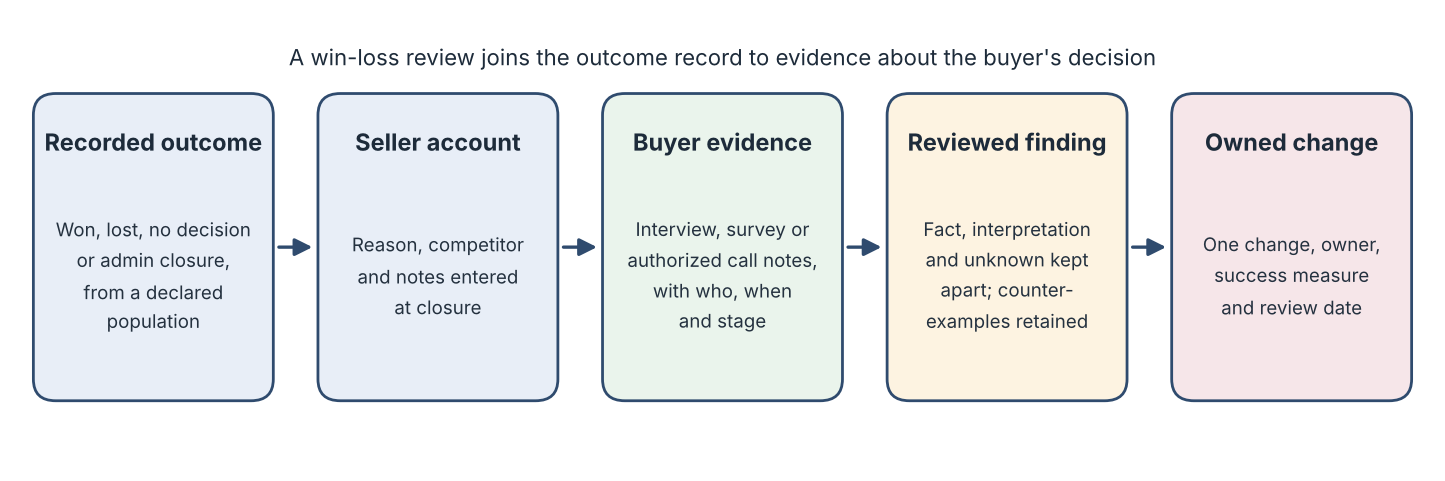
Diagram: a win-loss review connects each recorded outcome to the seller's account and to buyer evidence before anyone assigns a change.
A review does not need a new platform to start. It needs a frozen question and a disciplined sequence:
- Freeze the question and the population. Write down the question, which opportunities qualify, the date basis and the as-of date. Export the opportunity IDs so later reports can be reconciled against them.
- Check the records before interpreting them. Look for administrative closures, reassigned pipeline, deals whose close dates moved, still-open deals and missing origin links. Decide how each is treated and count every exclusion.
- Choose cases openly. Select won, lost and no-decision deals by a stated rule, not by whichever story is most memorable. Record who was invited and who did not respond.
- Reconstruct each decision. Use notes, authorized call recordings and buyer feedback. Separate what someone reported, what the reviewer interprets and what remains unknown.
- Compare, and keep the counterexamples. Look across outcomes and relevant segments. A plausible theme is a hypothesis until more evidence supports it; a won deal with the same "problem" as the losses is worth more attention, not less.
- Assign one change. Give it an owner, a success measure and a review date. When win rate later moves, consider what else changed before crediting the intervention.
What evidence should management request?
When a team brings a win-loss finding to leadership, these are reasonable questions to ask before approving a change:
| Question | Evidence to request | Warning sign | Owner | Next check |
|---|---|---|---|---|
| What exactly does the rate measure? | Numerator, denominator, population, date basis and as-of date | The same chart labelled "win rate" in two meetings with different numbers | RevOps | Reconcile both to opportunity IDs |
| What was left out? | Count of excluded records by category | Exclusions shown only as a footnote, or not at all | RevOps / sales leadership | Review each exclusion rule |
| Did the population move? | Original and current close dates, where history exists | The rate improved while open deals slipped out of the period | Sales operations | Compare the expected-quarter cohort |
| Where did each reason come from? | Seller selection, notes, buyer statement or reviewer interpretation | One field treated as the cause | Win-loss program owner | Have a second reviewer classify a sample |
| Who did we hear from? | Eligible, invited, responded and interviewed counts by outcome | Findings based on whoever answered first | Program owner | Check whether non-responders differ |
| When did the issue enter the decision? | Respondent role, stage and date for each observation | Pre-sale concerns mixed with post-sale experience | Product marketing / customer success | Split the evidence by lifecycle stage |
| Does the dashboard match the report? | Side-by-side totals for the same filters and running user | Executive view differs from the analyst's report | Salesforce admin | Rebuild the component from a tested report |
| Did the last change happen? | Named owner, completion date and follow-up review | Repeated findings with no recorded action | Sales leadership | Review at the agreed date |
What to fix first, and when outside help makes sense
Start with the population and the outcome labels. If the number itself is unstable, buyer stories will be argued away. Then repair the evidence and the workflow that collects it. A new dashboard cannot fix buyer access or unclear ownership.
Be careful with required fields. They can make sense, but more mandatory entries add work for sellers without improving accuracy. The Salesforce guidance on making a field required shows that page-layout, field-level, validation-rule and Dynamic Forms requirements apply differently; a page-layout requirement, for example, does not apply to API updates. Our article on opportunity stage requirements walks through keeping requirements proportionate and protecting legitimate updates and integrations. For broader field and data-quality habits, see Salesforce data quality.
A small evidence set can justify a local process change without proving a company-wide strategy. Independent interviewers can sometimes hear things a seller cannot, and AI tools can help organize notes, but neither is required to begin. Most teams can start with the reports, fields and notes they already have, provided the definitions are agreed and the gaps are visible.
Outside help is most useful when the problem sits between teams: when RevOps, sales leadership and product marketing each have a different number, when historical data has to be reconstructed, or when reason capture, reporting and integrations all need to change together.
Common questions
Should no-decision deals count in win rate? Keep them in the overall closed-decision rate, because the buyer's choice to do nothing is a real outcome. A competitive-only rate can be useful too, as long as it is labelled separately and doesn't replace the overall figure.
Why do count-based and value-based win rates differ? Large deals weigh more in the value-based rate. A team can win most small deals and lose a few large ones, producing a healthy count rate and a weak value rate. Both are worth watching.
Can Salesforce show what our win rate looked like last quarter? Only if the relevant information was kept. Current fields show current values. Field history and reporting snapshots capture changes from the time they are set up, within retention limits, so start keeping what you will need before the next review.
Bring one report and a few puzzling deals
If your win-rate report and your sense of why deals are lost don't line up, bring one win-rate report and a few deals where the recorded loss reason doesn't explain the decision. Logic Conduit can help trace the definitions, data capture and reporting behind the discrepancy, then scope a practical repair with your team, whether that is clearer outcome rules, better reason and evidence capture, reports that reconcile, or the integration work that connects them. Get in touch to start that conversation.