Salesforce Campaign Attribution: Are You Making Budget Decisions in the Dark?
Salesforce campaign attribution tells you which marketing campaigns get credit for pipeline and revenue, but those numbers are only as reliable as the records behind them. This article explains what Salesforce actually measures, five ways attribution can mislead a budget decision, and the questions to ask before you increase or cut marketing spend.
Consider a familiar budget meeting. Marketing asks for another $150,000 for events. Sales says the deals came from existing customer relationships. Finance points out that two Salesforce reports credit some of the same deals differently. Should you increase event spending, cut it, or put the money somewhere else?
Making that call from an unchecked attribution report is like navigating a ship at night with bright, precise instruments that nobody has tested. The readings look exact. That doesn't make them accurate.
You don't need perfect attribution to make a good decision. You need evidence that's good enough for a better decision, with the uncertainty out in the open. That starts with knowing how the instruments are wired.
What Salesforce Campaign Attribution Actually Measures
Salesforce doesn't watch buyers and work out what persuaded them. It reports relationships between records that people and systems create:
- Campaigns represent marketing activities such as a webinar, trade show or email sequence.
- Campaign members are the leads and contacts associated with a campaign.
- Opportunities are potential deals, with an amount and a stage.
- Opportunity contact roles record which contacts are involved in a deal.
- Primary Campaign Source is a single field on the opportunity. Salesforce's default influence model assigns 100% of the credit to that one campaign.
- Campaign Influence associates several campaigns with one opportunity. Standard auto-association looks for campaign members who also hold a contact role on an open opportunity.
Every attribution number is built from those links. A missing link makes credit disappear; a wrong one sends it elsewhere. Even when every link is correct, a report shows association, not proof that the campaign caused the sale. (Attribution is also different from acquisition source; for that question, see lead source tracking.)
Five Ways Salesforce Attribution Can Mislead Management
1. Missing contact relationships hide marketing's contribution
Decision at risk: cutting a program that is actually reaching active buyers.
Campaign influence needs a person on both sides of the link: a campaign member who is also a contact role on the opportunity. Without contact roles, Salesforce has nothing to connect.
In a Salesforce Developer Edition org, Priya Raman, COO of Cedar Ridge Logistics, is a member of an October webinar campaign. Her company has a $45,000 opportunity at the proposal stage, but with no contact roles and a blank Primary Campaign Source, nothing ties that deal to the webinar.
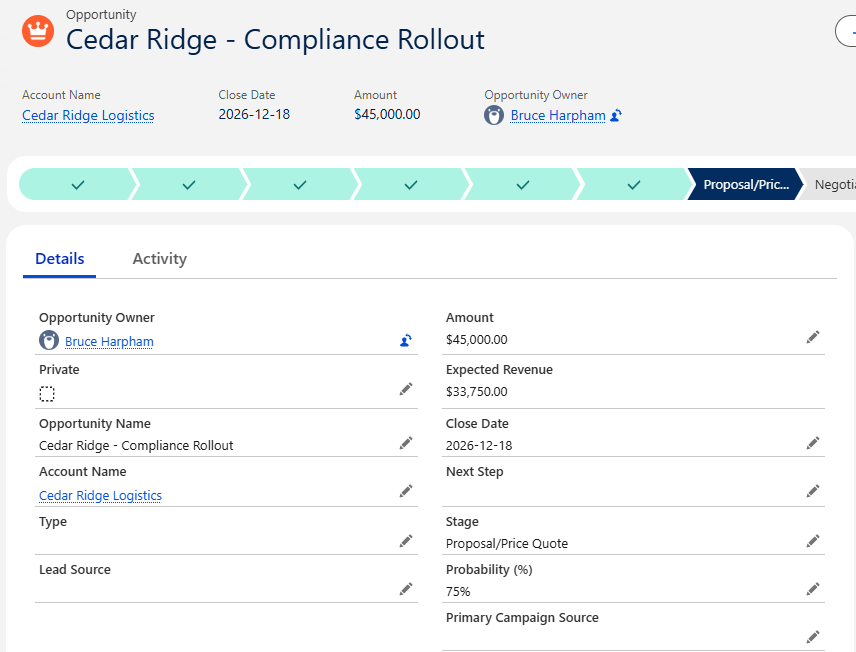 The $45,000 Cedar Ridge opportunity: Primary Campaign Source is blank, and the record has no contact roles.
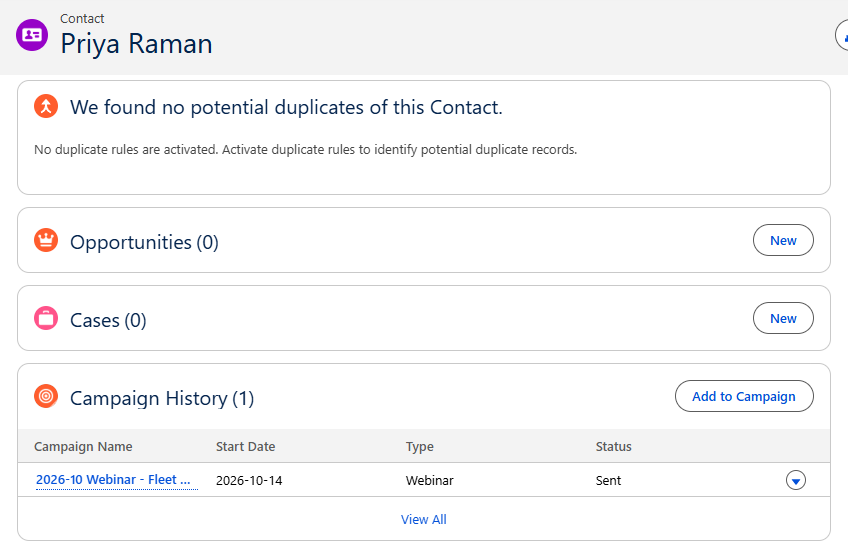 Priya Raman is a member of the webinar campaign, but she isn't linked to her company's opportunity.
This is a common complaint. In a January 2026 r/hubspot thread, a fractional RevOps consultant described a HubSpot-plus-Salesforce business where many opportunities had no associated contacts, and where earlier attribution workflows had lost leadership's trust.
Ask: How much closed-won and open pipeline value has no contact roles?
Proportionate remedy: Report on opportunities without contact roles, fix the largest open ones, and build contact roles into the sales process before rebuilding attribution logic. Timing matters: Salesforce doesn't create influence records for closed opportunities, so late clean-up won't recover credit on closed deals.
2. One-campaign credit oversimplifies complex buying journeys
Decision at risk: over-funding whichever activity sellers tend to pick as the "source."
Primary Campaign Source is simple, and that's a real strength. But it gives one campaign all the credit. In our example, the standard Campaigns with Opportunities report credits the webinar with exactly one deal:
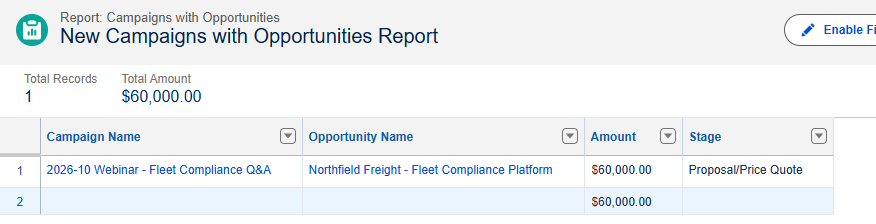 A Campaigns with Opportunities report (start-date filter: current fiscal quarter). The webinar is credited with $60,000 through Primary Campaign Source. The Cedar Ridge deal doesn't appear.
Even on the Northfield deal, a second contact, the fleet safety manager, is a member of a separate email campaign. Under the default model, that campaign gets no share of the credit.
Multi-campaign influence captures more interactions, but it isn't automatically better. Salesforce counts every campaign member regardless of member status. Priya's status is "Sent," so without association rules her invitation would count the same as attendance.
Ask: Do we need to know every touch, or only which campaign opened the door?
Proportionate remedy: Pick the simplest model that answers your actual budget question, and write down what it ignores.
3. Integration problems break the evidence chain
Decision at risk: judging campaigns on data that never fully arrived in Salesforce.
When a marketing platform manages campaign membership, Salesforce attribution is only as complete as the sync. Salesforce's Account Engagement guidance notes that prospects sync when they are assigned to a user, queue, or group. In a September 2025 r/salesforce discussion, a practitioner complained about sync delays and reporting upkeep: one experience, not proof of a systemic defect, but a reason to check.
Ask: If we pick five engaged prospects in the marketing platform, can we find each one's campaign membership and opportunity in Salesforce?
Proportionate remedy: Assign an owner for campaign and member data, review sync errors, and trace a small sample end to end. If the same cross-system gaps keep coming back, a defined repair such as a Salesforce Integration Sprint may be justified. A report change won't fix a broken handoff.
4. Different attribution assumptions produce competing revenue numbers
Decision at risk: a leadership stalemate where each department brings its own number.
For an opportunity with several contact roles in several campaigns, Salesforce documents first-touch, last-touch and even-distribution approaches for Account Engagement users. Each gives a different answer from the same records. Add an outside multi-touch tool or a holdout test and you can easily end up with three figures that don't match. A June 2026 r/b2bmarketing post describes exactly that after a replatforming, with the CRO no longer trusting any of them.
Ask: Which model produced this number, and what changes under another reasonable model?
Proportionate remedy: Separate three issues: data integrity (are the records right?), model choice (how should credit be shared?) and causal measurement (would the revenue have happened anyway?). Attribution models can help with the first two. Only a designed test or analysis addresses the third.
5. Report configuration or automation creates misleading totals
Decision at risk: trusting a report that is technically valid but answers a different question.
Salesforce's article on the Campaigns with Influenced Opportunities report explains that any campaign ever saved in Primary Campaign Source is reported even if later replaced, while influence records added with the New button don't appear. It suggests a custom report type built on Opportunities with Campaign Influence instead.
Settings also change which report types exist. After we enabled Customizable Campaign Influence, the Campaigns with Influenced Opportunities option below disappeared from our org's list, consistent with Salesforce's note that the newer feature hides Campaign Influence 1.0.
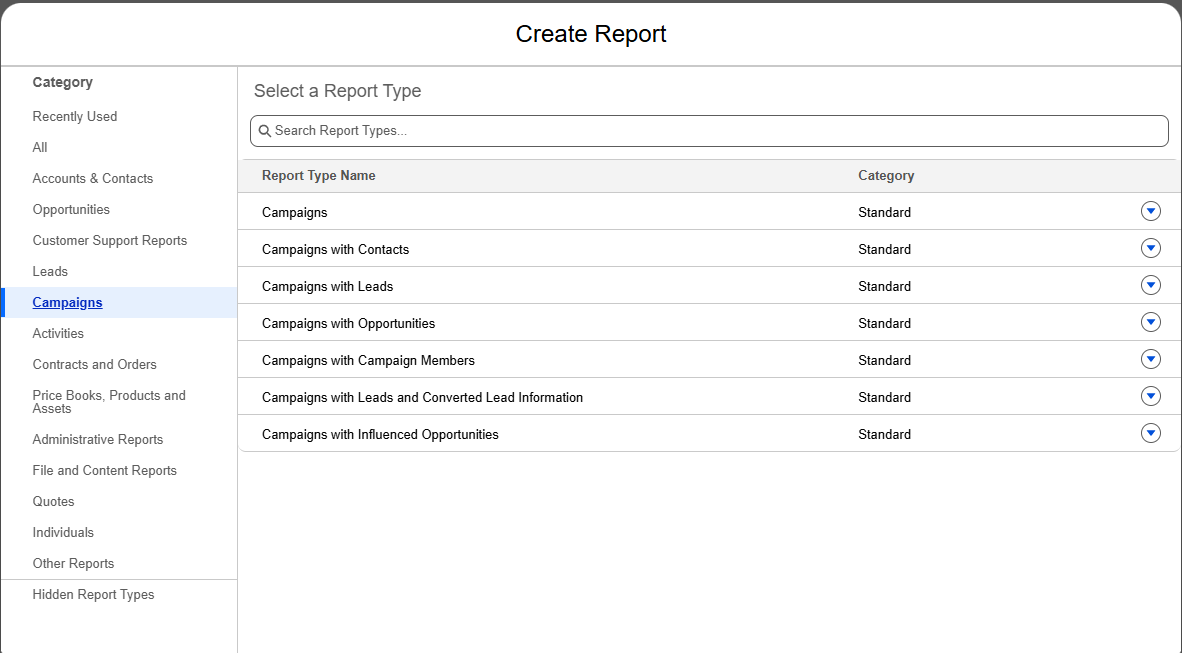 Similar report names, different logic: Campaigns with Opportunities follows Primary Campaign Source, while Campaigns with Influenced Opportunities also follows contact roles and campaign membership.
Custom automation adds another risk. Salesforce warns that a custom influence model built with Apex triggers can create duplicate influence records during recalculation unless the code checks for existing records. Nobody notices until totals look inflated.
Ask: Which report type and filters produced this figure, and has anyone checked it against the underlying opportunities?
Proportionate remedy: Document the report type, filters and model behind every number shown to leadership, and reconcile one total line by line.
A $150,000 Budget Decision With Two Very Different Answers
Suppose the events program from that meeting looks like this. The same deals, measured two ways, point to opposite decisions:
| Reported view | Traced view | |
|---|---|---|
| How credit is counted | 100% to events wherever events is the Primary Campaign Source | Mis-credited renewals removed; events gets 25% of deals with four campaign touches |
| Closed-won revenue credited to events | $180,000 | $105,000 ($60,000 new business + 25% of $180,000 shared deals) |
| Open pipeline credited to events | $240,000 | $150,000 (after removing $90,000 of renewal opportunities) |
| Event program cost | $150,000 | $150,000 |
| Credited closed-won ÷ cost | 1.2 | 0.7 |
| Proven incremental return | Unknown | Unknown |
The reported view supports expanding events; the traced view suggests the program isn't paying for itself. Neither proves what revenue the events caused. Credited revenue isn't profit, and the shared deals might have closed anyway. Note, too, that the traced view counts the $180,000 of shared deals at 25% rather than adding their full value, because three other campaigns touched the same deals.
A reasonable decision here might be to hold the events budget flat for one cycle, fix contact roles, and compare deal progression for accounts that attended against similar accounts that didn't.
Questions to Ask in Your Next Budget Meeting
- Can we trace the three largest credited deals to real campaign interactions?
- How much closed-won value has missing contact roles or campaign links?
- Which attribution model and report type produced this number?
- Do Sales, Marketing and Finance agree on which revenue is included, and on what "influenced" means?
- What changes if we use a different reasonable model?
If nobody can answer the first two, debating the model is premature. The groundwork for these checks overlaps with the reporting habits in Salesforce campaigns best practices and the pipeline questions in marketing to sales handoff.
Fix the Measurement Before Buying More Software
An attribution tool built on incomplete relationships will produce more sophisticated versions of the same gaps. A bounded diagnostic is usually the better first step:
- Pick one disputed report and a representative sample of opportunities, including the largest deals.
- Trace the relationships: campaign members, contact roles, Primary Campaign Source and any influence records.
- Compare the setup: source records, model settings, report type and filters.
- Document what's unknown, such as deals with no contacts, unsynced prospects and recurring exceptions.
- Recommend the smallest reliable repair.
Many problems need only reporting changes and sales-process discipline: a missing-contact-role report, a documented definition, a corrected filter. Others justify configuration or integration work, such as sync failures, duplicating automation or campaign data split across systems. If the gaps go beyond campaigns, see Salesforce data quality.
Make the Next Marketing Decision With Better Evidence
The instruments don't have to be perfect. They do need to be checked, and everyone at the table should know how far to trust them.
Can Your Team Trust Its Marketing Revenue Reports?
Before increasing your marketing budget, or cutting a program that might be working, find out what your Salesforce reports can actually support.
Logic Conduit can help investigate disputed campaign attribution, trace important Salesforce data relationships, and identify the configuration or integration issues behind unreliable reporting.
Bring one report your leadership team questions and a few examples of deals that look incorrectly credited. We'll discuss a focused assessment rather than assuming you need a reporting rebuild. Contact Logic Conduit.