Salesforce Technical Debt: Why Small Changes Become Expensive Projects
You ask for a pricing change, a simpler approval or one new field on a sales report. The request looks small. Then come the meetings to work out what depends on it, the revised estimate and the warning that another process could break.
Meanwhile, sales keeps using a spreadsheet and someone handles the exceptions by hand.
Salesforce technical debt is the extra work created when earlier design decisions, workarounds and deferred maintenance make today's system harder to change or operate. For a manager, it shows up in the cost and reliability of ordinary work: getting a quote out, introducing new terms or giving staff a process they can trust.
Ask: which business task has become unnecessarily slow, costly or fragile—and what would a repair change?
Why a small request can carry a large bill
A business change can have a wider reach than its description suggests. A pricing field may feed a quote, an approval, an invoice handoff and a management report. An old exception may still be built into several places, even after the reason for it has disappeared.
The team must then investigate those connections before it can estimate the change confidently. If the connections are poorly understood, the estimate includes time for discovery and the possibility of repair afterward.
That is where managers can end up paying repeatedly for the same uncertainty. Each new request starts another round of questions about how the existing system works.
Some complexity earns its keep: an unusual contract or approval may protect an important commercial requirement. The useful distinction is whether the current design still serves that requirement at an acceptable operating cost.
Business changes need too much investigation
If a new price or process needs a small project just to discover what it will affect, that investigation belongs in the cost of operating Salesforce.
Take one recent request and ask the team to separate:
- Time spent agreeing what the business needed.
- Time spent finding the affected processes, fields and reports.
- Time spent making and checking the change.
- Time spent repairing unexpected effects.
Those categories lead to different decisions. Unclear requirements need a clearer business owner. Repeated dependency investigation may justify better documentation, simpler configuration or a more focused review of the affected workflow.
Employees wait on a system built around old habits
In a May 2026 practitioner discussion, one contributor described a heavily customized interface filled with grids. Users complained that Salesforce was slow; the contributor connected that experience to loading very large numbers of records on each page.
For the manager, the relevant question is how that delay affects repeated work.
Watch an employee complete a common task: find an account, update a deal, prepare a quote or check an approval. Record where the time goes. Does the employee wait for a page, search through irrelevant information or leave Salesforce to finish elsewhere?
A redesign should be judged against that task. A cleaner screen is useful when it removes steps, reduces waiting or makes the next action clearer. Recreating the same overloaded process with newer technology may preserve the cost.
Ask for a comparison of the same task before and after a proposed repair, using representative records and the employee's normal access. Keep the employee involved in deciding whether the change actually helps.
Quoting depends on whoever remembers the exceptions
A July 2021 practitioner report describes joining a team with years of accumulated quoting rules. The author said it could take an hour or more just to explain why a quote had a particular price.
When explaining a price becomes an investigation, sales and finance have another task to complete before they can resolve the customer's question.
Trace a recent quote from the seller's request to the customer-ready version. Identify where someone had to explain a rule, correct an output, find a price or ask which exception applied.
Then distinguish the work that needs expert judgment from the work repeated because the system does not support the agreed process. You may need a clearer pricing rule, a simpler approval or a better handoff before you need another application.
For changing deal terms, the Salesforce discount-approval guide examines why an earlier approval may no longer cover the current deal. That is the kind of business requirement a repair needs to preserve.
Fixing one thing creates another interruption
An administrator in a February 2026 report described inheriting undocumented Salesforce processes. Opportunity changes triggered unexpected sales emails. Disabling one process brought complaints that something else had broken.
The business pays for that uncertainty through interruptions, repeated investigation and a queue of improvements that becomes harder to plan.
Start with the process people are trying to complete. Agree what should happen, which users depend on it and which exceptions are legitimate. Have the team identify the connected automation before changing it.
The check after repair should cover the intended result and the related work that must continue. If you simplify an approval, verify that legitimate orders still move forward and the required controls still apply.
For problems crossing into the ERP, the Salesforce ERP integration guide covers ownership, mapping and recovery. Keep that wider handoff in view when the symptom spans systems.
Put a cost against one recurring problem
A count of old fields or automations does not tell you which repair deserves funding. Connect the proposed work to something the business can measure.
Choose one recurring symptom and record its frequency, the people involved and the work it creates.
Suppose three employees each spend four hours a week investigating exceptions and correcting records. That is 12 hours a week. At an assumed fully loaded cost of $65 an hour, the workload represents $780 a week in staff capacity.
Work out how much of that effort a proposed repair could realistically remove. Freed capacity may help the team handle more work; a reduction in payroll is a separate business decision.
Track elapsed delay separately from hands-on effort. A quote can wait two days while requiring only an hour of staff time. Both may matter, but adding them together would misstate the labor cost.
Useful measures include:
- Time from an approved business request to a working change.
- Hours spent investigating and repairing exceptions.
- Quote preparation time, waiting time and revisions.
- Time needed to complete a frequent user task.
- Interruptions and follow-up repairs after a release.
Use the same definitions before and after the work. If inconsistent records are part of the problem, the Salesforce data-quality guide provides a complementary starting point.
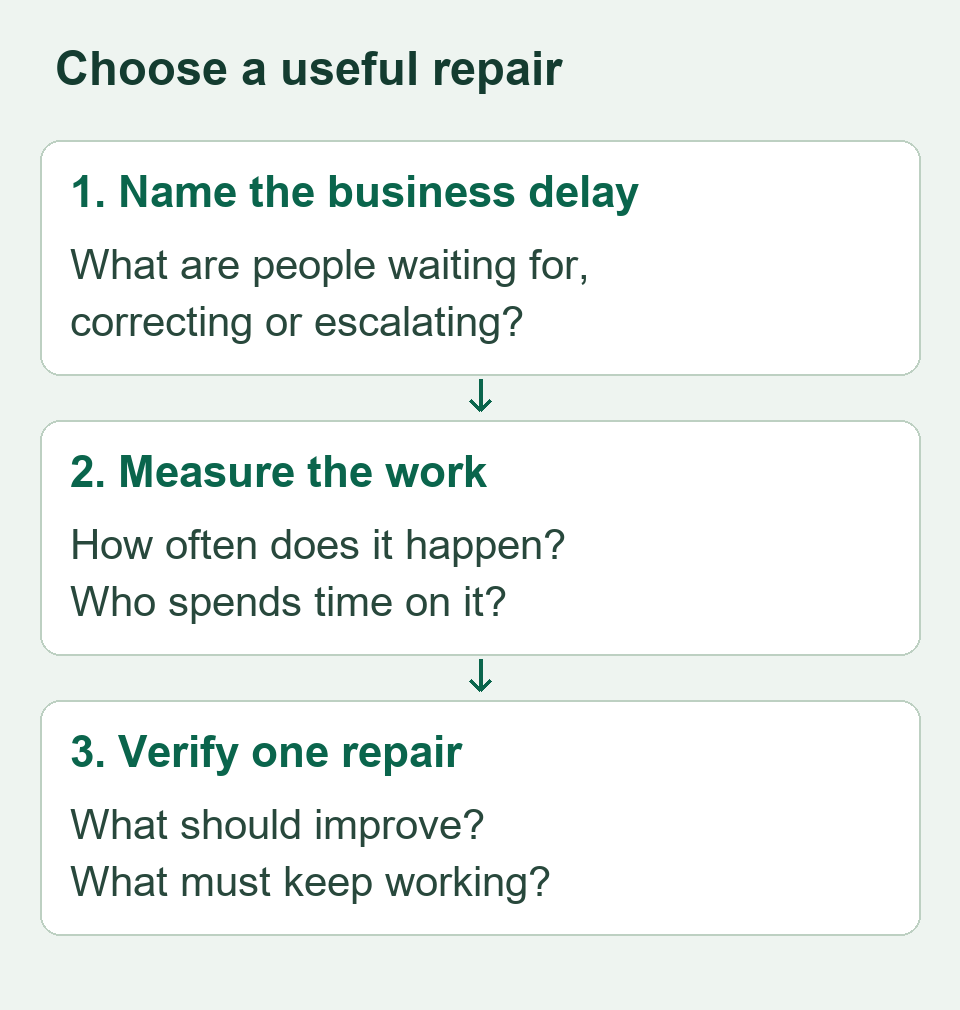
Choose the repair by the business result it needs to deliver.
Fund a defined repair with a clear finish line
A request to “clean up Salesforce” is difficult to price and easy to expand. A request to reduce the investigation behind a pricing change or remove repeated quote corrections gives everyone a clearer starting point.
For your own project, ask for a proposal that answers four questions.
What recurring problem are we addressing?
Name the affected task, its owner and the current workload or delay. Include an example that the implementation team can trace.
Why is this the right intervention?
The options may include leaving the process alone, clarifying ownership, simplifying existing configuration or replacing part of the design. Ask what each option costs to deliver and maintain, and what happens if you defer the work.
What evidence will show that it helped?
Agree the expected behavior, representative cases and business measure before implementation. Include related work that must keep functioning and any manual steps that will remain.
Who will own it afterward?
Name the person who accepts the result, the team that handles exceptions and the person responsible for future changes. Give them usable instructions and enough context to maintain the process.
Start with a repair small enough to verify. The result should help you decide whether to extend the work, change direction or stop.
Bring one expensive Salesforce problem to the conversation
Choose a task your team keeps waiting for, correcting or escalating. Bring Logic Conduit one example, the people affected, its frequency and what a satisfactory result would look like.
We can discuss where the cost is coming from, what evidence would clarify the cause and how to scope a repair with a clear business purpose.