Salesforce MQLs: Are Sales and Marketing Playing From the Same Score?
Imagine the monthly executive meeting. The marketing director reports that marketing qualified leads are up 35%. Campaigns are bringing in more prospects at a lower cost. Then the head of sales presents: qualified pipeline is flat, and sellers are struggling to turn those leads into worthwhile conversations.
The CEO has heard two credible reports and still cannot tell what to fund next.
Marketing delivered the MQL growth it was asked to produce. Sales concentrated on deals most likely to meet its revenue target. Each team has sound reasons for its decisions. Together, they have made little progress toward the company's pipeline goal.
An orchestra needs different instruments playing different parts. The CEO's role is the conductor's: set the direction, agree the timing and listen to the whole performance. When marketing's part ends at “MQL delivered” and sales' part begins at “ready to buy,” the CEO must resolve the gap between them.
That makes Salesforce MQL management a leadership responsibility. The CEO sets the shared expectations; marketing, sales and the Salesforce owner translate them into qualification rules, follow-up commitments and reports. Salesforce should show where a prospect qualified, who accepted responsibility and what happened next. If those records tell different stories, the next budget decision rests on an argument nobody has settled.
First, ask what your Salesforce MQL report actually counts
“MQL” means marketing believes a person merits sales attention under agreed criteria. It does not prove sales accepted the lead or qualified a deal. Even within Salesforce products, the label needs checking.
On narrow screens, scroll the table sideways.
| Product or report | What it measures | Management's decision |
|---|---|---|
| Sales Cloud lead process | Lead Status values describe the lead's state and can be configured for your process. | Which event means MQL, and whether existing Contacts qualify too. |
| Account Engagement, formerly Pardot: Lifecycle report | MQL counts prospects created in the selected period that became assigned. SQL counts prospects created in that period that are associated with opportunities. | Whether assignment and opportunity association match your qualification gates. |
| Account Engagement qualification | Scoring reflects interest through activity; grading evaluates fit. | Which combination merits a handoff. |
| Sales Cloud Einstein Lead Scoring | Ranks leads against patterns of prior lead conversion. | Whether that conversion outcome matches the business goal. |
| Marketing Cloud Next scoring | Supports engagement and fit rules for people and accounts. | How scores trigger qualification and a recorded handoff. |
Sources: Salesforce documentation on Lead Status, Lifecycle metrics, Account Engagement qualification, Einstein Lead Scoring and Marketing Cloud Next scoring. Features and setup depend on your product and edition.
Account Engagement assignment can happen through imports, CRM sync, APIs or manual actions. Its Lifecycle MQL count may therefore differ from a custom report of people who met your sales-ready criteria during the month. Put the report definition beside the business definition before discussing performance.
Marketing Cloud Engagement's Journey Builder also needs care: its Convert Lead activity does not verify qualification before conversion. Automation can execute a decision without validating its commercial basis.
Change the scorecard before blaming either team
Suppose marketing must deliver 270 MQLs while controlling cost per MQL, and sales must achieve this quarter's revenue target with its existing team. Marketing has a reason to increase handoffs. Sales has a reason to prioritize buyers likely to close soon. An early-stage prospect can meet marketing's criteria and still lose out for sales time.
Ask: what shared outcome makes producing and working these MQLs worthwhile?
Ashley McAlpin, identified in her firsthand account of rethinking MQLs as FormAssembly's VP of Marketing & Sales Development, argued for measuring MQL-to-SQL progression and connecting departmental accountability to business outcomes. Published in 2021 and updated in 2024, the article offers practitioner judgment rather than a measured result for a particular incentive plan.
Keep controllable responsibilities visible: marketing supplies suitable demand; sales handles it promptly and qualifies consistently. Add a shared measure of whether comparable groups of MQLs produce qualified opportunities.
Revenue alone is too distant to explain many handoff failures. Marketing cannot control every sales-capacity or closing decision. Acceptance alone is weak if a rep can click “accepted” without committing to work. Observe the operating measures before redesigning compensation.
Agree where marketing qualification ends and sales responsibility begins
Use these proposed management definitions, adapting them to your business:
- MQL: the person meets agreed fit and readiness criteria.
- Sales accepted lead (SAL): a named owner acknowledges responsibility to work it.
- Sales qualified lead (SQL): sales has evidence of a relevant business need and a credible next step.
- Qualified opportunity: the deal meets your pipeline entry requirements.
- Outcome: progress, win, loss, rejection or nurture, with dates and reasons.
You may combine SQL and qualified opportunity into one gate. Account Engagement's Lifecycle SQL label uses opportunity association; keep it separate from any different internal definition.
Salesforce lead conversion relates a lead to an account and contact, with an opportunity created or associated as appropriate. Conversion alone does not prove a new qualified deal exists.
For a hypothetical software company, an MQL might require a supported region, suitable company size and a demo request. A webinar attendee without a buying signal might remain in nurture. Acceptance commits an owner to act; later qualification establishes whether a deal deserves pipeline space.
Our Salesforce lead scoring guide covers disagreements about the score itself. Management must decide what crossing the threshold means for both teams.
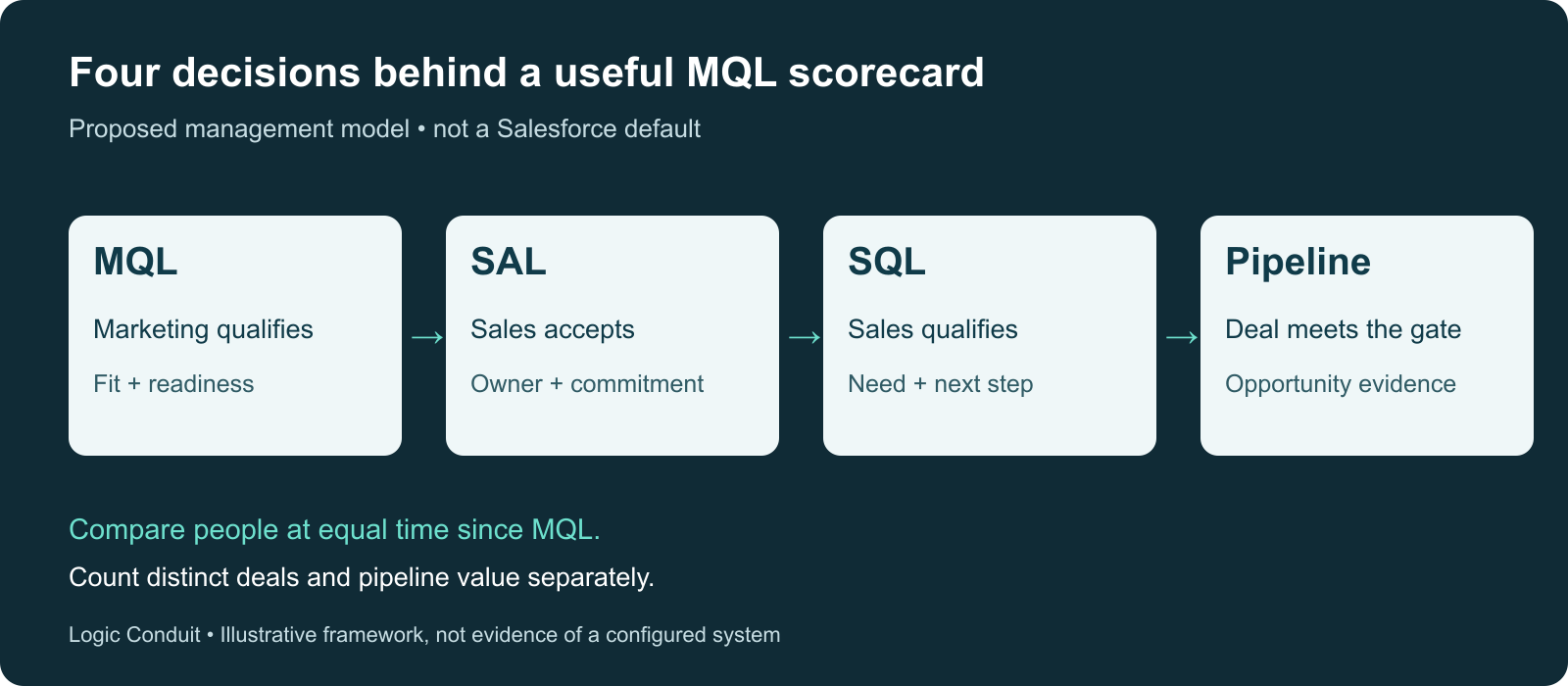
Proposed management model; agree stage definitions for your business.
Compare the same MQLs over the same amount of time
Dividing this month's opportunities by this month's MQLs mixes populations. Opportunities may come from earlier MQLs, outbound selling, customers or existing Contacts.
Instead, group people by when they first became MQLs and follow that cohort for an agreed period. Report current workload separately.
More MQLs, unchanged opportunity output
These invented cohorts use the same qualification rule, count each person once and have each had 60 days to progress.
On narrow screens, scroll the table sideways.
| Measure within 60 days of first MQL | Cohort A | Cohort B |
|---|---|---|
| Unique people becoming MQL | 200 | 270 |
| People accepted by sales | 120 | 135 |
| Acceptance rate | 60% | 50% |
| People linked to a qualified opportunity | 30 | 30 |
| MQL-to-qualified-opportunity rate | 15% | 11.1% |
MQL volume grew 35%; the number of people reaching a qualified opportunity stayed flat. Investigate segment mix, qualification changes and sales backlog before concluding that lead quality fell.
This table does not measure pipeline value. Several people may belong to one deal. Count distinct opportunities and amounts separately, with a rule for deals linked to multiple people or cohorts.
Choose an observation window that fits your sales cycle; 60 days is illustrative. Compare cohorts at equal ages and mark newer ones incomplete. Show counts beside percentages, particularly with small samples.
Request six measures leadership can act on
On narrow screens, scroll the table sideways.
| Measure | Definition to settle | Decision |
|---|---|---|
| MQL volume and mix | Unique first-time MQL people by segment and intent; repeats separate | Are we reaching suitable buyers? |
| Sales acceptance | Cohort MQLs accepted within the agreed interval ÷ all cohort MQLs | Do qualification and capacity agree? |
| First sales action and backlog | Time from handoff to defined human action; unworked records visible | Are suitable prospects waiting? |
| Rejection and nurture reasons | Separate poor fit, future timing, duplicates and missing information | Change targeting, nurture or capture? |
| Qualified-opportunity progression | Cohort people reaching the gate within the observation window ÷ cohort MQLs | Are handoffs producing opportunities? |
| Distinct pipeline and outcomes | Deduplicated deals, value at an agreed date, then wins/losses | Is the resulting business worth pursuing? |
Retain source, segment, sales team and qualification-rule version. A blended rate can fall when the mix changes even if each segment performs as before. For cost measures, state which marketing and selling costs are included.
Ask your Salesforce owner to prove the record trail
Trace known people through the reports before commissioning another dashboard. Request:
- First MQL timestamp, qualification reason and rule version.
- Handoff timestamp, receiving owner, acceptance decision and time.
- First qualifying sales action, distinguished from a planned task or automated acknowledgement.
- Rejection or nurture reason, decision date and next owner.
- Links to relevant opportunities, including people already recorded as Contacts.
These are proposed requirements, not guaranteed standard fields. If people qualify repeatedly, decide whether first/latest dates suffice or whether each episode needs a dated event record. Overwriting one date loses the earlier sequence.
In a May 2023 practitioner discussion, an operations user described using MQL dates and campaign-member reports while struggling to report across Leads and Contacts. A respondent described a custom qualification object used at a previous employer. Those accounts identify a problem to investigate, not a universal need for another object.
Check existing fields first. Salesforce documents mapping them during lead conversion; verify your custom lifecycle fields survive the intended conversion path.
Keep MQLs without opportunities in the denominator. Reconcile converted Leads and existing Contacts. Avoid counting a deal's full value once per related person or campaign. Our Salesforce report types guide explains how report design drops records or inflates totals.
Check refresh timing too. Salesforce says its external Account Engagement datasets update every 24 hours and documents possible discrepancies involving date filters and time zones. Use the same cutoff and population when reconciling B2B Marketing Analytics.
Put ownership and deadlines into the handoff agreement
Sercante's 2025 practitioner discussion of handoffs recommends explicitly agreeing stage definitions, handoff triggers, response expectations and shared measures.
Give your service-level agreement five concrete answers:
- What qualifies, what context accompanies it, and which inquiries take priority?
- Which recorded event starts the clock, under which business hours and time zone?
- What are the separate deadlines for acceptance and meaningful outreach?
- Who covers absences, full queues and missed deadlines?
- What reason and next owner are required for rejection or nurture?
A team might choose acceptance within four business hours and personal outreach within one business day for one inquiry class. Those are illustrative commitments, not research benchmarks. Set deadlines you can staff, with faster handling where the buyer's request warrants it.
Keep overdue MQLs visible: averages based only on worked records hide people still waiting. Investigate missing logged activity before assuming no outreach happened. Our marketing-to-sales handoff guide covers the broader tracing exercise.
Leave the next management meeting with one decision
Bring marketing, sales and the Salesforce owner together. Compare two equally mature cohorts and inspect accepted, rejected and overdue examples. Samples locate defects; full cohorts measure rates.
On narrow screens, scroll the table sideways.
| Finding | Question | First response |
|---|---|---|
| Rejections mainly cite poor fit | Are we qualifying people we cannot serve? | Review criteria and one source segment. |
| Suitable MQLs wait untouched | Is routing, coverage or workload blocking action? | Repair ownership and backlog handling. |
| Marketing and sales totals disagree | Do dates, populations and counting units match? | Reconcile known records. |
| New cohorts appear weaker | Have both groups had equal time? | Compare equal-age outcomes. |
| Acceptance is high; qualification low | Is acceptance meaningful? What does discovery reveal? | Inspect accepted records and qualification evidence. |
| Counts rise after a rule change | Did demand grow, or eligibility expand? | Compare rule versions separately. |
Choose one repair, an owner and a review date that allows outcomes to emerge. If historical timestamps are missing, label the gap and begin reliable capture. Better reporting cannot create demand or prove marketing caused a sale; it helps distinguish demand problems from operational failures before leadership moves budget.
Bring the two reports that disagree
Start internally if your team can agree definitions and reconcile the records. Outside help becomes useful when qualification, routing, integrations and reporting cross departments and nobody can explain the number end to end.
Contact Logic Conduit with your MQL report, pipeline report and the decision they fail to support. We can help scope a review of qualification, sales acceptance, lifecycle dates and the Salesforce record trail, then identify a first repair and how to validate it.
The CEO's job is to make those departmental results add up to a business result. A shared Salesforce scorecard gives that conversation evidence, owners and a next action.
Research checked November 3, 2026 (America/Toronto). Salesforce descriptions are documentation-based; no live Salesforce configuration or testing was performed for this article. The meeting, figures and proposed operating rules are illustrative.