Salesforce Integration Services: What Are You Paying For?
Your Salesforce integration has a monthly bill. It also has an unofficial support team: the employees who copy orders, chase missing updates and reconcile numbers by hand.
If you're buying Salesforce integration services, put that extra work in the brief. Ask which manual steps the project will remove, what happens when a record fails, and who is responsible after launch.
Salesforce integration services cover the work of designing, building, testing and maintaining connections between Salesforce and other business systems. The scope should name the records, business rules, failure handling and ongoing responsibilities included in the price.
Use the questions below to compare proposals, challenge vague estimates and decide whether a focused consultant can handle the work.
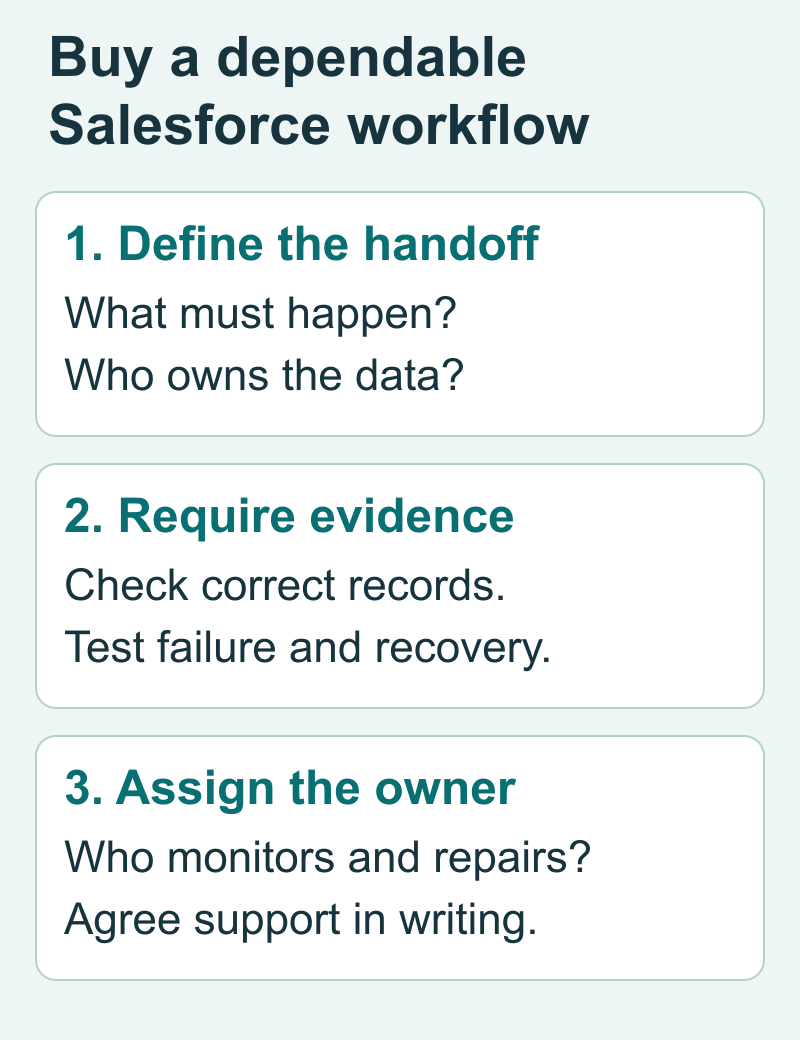
What problems should Salesforce integration services solve?
Start with an observable problem: repeated entry of customer information, missing sales handoffs, disputed reporting, or staff who spend hours checking whether updates arrived.
The accounts below are public, self-reported experiences and questions. They are not Logic Conduit testimonials or evidence of how often a product fails.
A working connection can still leave the business waiting
A commercial analytics manager described an unused integration contract intended to connect NetSuite and Salesforce. The project had stalled after an IT leader left, while separate data made reporting difficult. The project still needed someone to own delivery, regardless of which software the company bought.
A marketing practitioner reported that information was flowing from Marketing Cloud Personalization into Salesforce CRM, yet the segment membership needed for automation was missing. The connection was active, but the information needed for the next step was missing.
Ask a provider to demonstrate the Salesforce report, record or action your team needs at the end of the handoff.
An inherited Salesforce setup can hide the real scope
At a B2B manufacturer, a post-merger marketing employee inherited a Salesforce rollout covering three business units and found API errors in a connection involving multiple ERPs. They needed to understand and explain the setup under leadership pressure.
In a higher-education discussion, an implementation participant described dozens of integrations alongside poor scoping, limited acceptance validation and an unrealistic timeline.
Before commissioning a repair, establish which Salesforce automations, connected systems and teams the change touches. A narrowly priced proposal can become a much larger project if discovery skips those dependencies.
Check the Salesforce setup behind the connector
A nonprofit supporter considering a donation platform asked whether it would suit the organization's existing Salesforce NPSP setup when the documentation appeared to emphasize Nonprofit Cloud. That was a compatibility question before purchase, rather than a proven product failure.
An administrator planning to connect HubSpot with a new Salesforce instance wanted to avoid carrying poor-quality source data into the new environment.
Specify the actual Salesforce objects, permitted values, record relationships and business rules. For a concrete example of why this detail matters, see our guide to fixing HubSpot Salesforce sync errors.
Cost and responsibility need explaining together
One employee questioned recurring charges for a one-way ERP feed and built a replacement script, then asked what they might have overlooked. They also said the old sync had stopped for weeks without anyone noticing and was not business-critical. Their situation does not establish what another company's integration should cost.
A nontechnical requester separately asked why a Salesforce–NetSuite connection needed an integration platform and developers when simpler connections seemed easy.
You should be able to trace a proposal's cost to specific work and operating responsibilities. “Enterprise-grade” is not a substitute for that explanation.
Put the business handoff in the scope before choosing the tool
“Integrate Salesforce with our accounting system” leaves too much open.
A more useful starting point is:
When an approved Salesforce opportunity is ready for fulfillment, create the agreed order in the receiving system, return its reference to Salesforce, and make rejected or uncertain orders visible to the responsible employee.
That is an illustrative scope statement, not a description of a completed Logic Conduit project. It still needs decisions about eligibility, customer matching, products, prices, approvals and recovery.
Use a short written brief to resolve these seven questions:
- What starts the handoff? Name the business event and the Salesforce conditions that make a record eligible.
- What must arrive? List required fields, relationships and the destination action.
- Which system owns each value? Decide who controls customer identity, payment status, pricing and other shared information.
- How current must it be? Tie the acceptable delay to the decision or work that depends on it.
- What happens to exceptions? Identify unmatched customers, rejected values, duplicates and uncertain outcomes.
- Who accepts the result? Name the business owner who will check the completed workflow.
- Who operates it afterward? Assign monitoring, incident response, credential maintenance and change approval.
Include explicit exclusions. Historical cleanup, an initial data load, ongoing synchronization and a redesign of Salesforce automation are different work items, even when they affect the same records.
A small-business owner described reducing repeated entry through Salesforce automation while leaving a planned QuickBooks handoff with an assistant for the time being. The owner had chosen which work to automate first. A remaining manual step does not automatically justify the next project.
If the business case is still unclear, our Salesforce data sync planning guide explains how to assess repeated work, stale information and missed handoffs.
Which approach fits your Salesforce workflow?
Ask each provider to show how its proposed approach handles your Salesforce workflow, including the exceptions.
| Approach to evaluate | A reason to consider it | What the proposal must establish |
|---|---|---|
| Existing connector | Its supported workflow appears close to yours | Exact Salesforce objects and fields, update rules, exceptions, operating limits and support boundaries |
| Integration platform or middleware | You need a shared place to coordinate several connections | Required licenses, configuration work, monitoring, specialist skills and who maintains the flows |
| Custom Salesforce/API integration | Business rules or interfaces need a tailored implementation | Hosting where needed, code ownership, testing, diagnostics, recovery, documentation and support |
| Narrow repair of the existing setup | The required workflow already exists but a defined part fails | Confirmed cause, affected records, repair boundaries and evidence that recovery is complete |
Ask providers to explain why their proposed approach fits your Salesforce environment. Request a small demonstration of the riskiest requirement before committing to a larger build.
Be cautious when the answer is a platform name followed by a long list of possible future uses. Buy the capabilities your agreed scope requires, with a credible route to maintain them.
What drives Salesforce integration services cost?
Ask for the assumptions behind the estimate and separate implementation fees from subscriptions and ongoing operation.
The work to price includes:
- Discovery: understanding Salesforce configuration, the receiving API, existing dependencies and undocumented behavior.
- Mapping and business rules: translating records, relationships, statuses, currencies or approval conditions.
- Data preparation: matching customers, resolving duplicates, cleaning source values and loading historical records.
- Reliability: detecting failures, handling safe retries, resolving uncertain results and reconciling records.
- Testing and release: representative scenarios, realistic volumes, deployment, rollback or correction planning, and business acceptance.
- Ownership: documentation, handoff, monitoring, support coverage and future changes.
Volume can affect both the design and operating bill. Salesforce documents API consumption over a rolling 24-hour period and recommends planning new integrations alongside existing traffic. Ask the team to estimate normal demand, peaks and recovery traffic against your actual organization's entitlement.
For each proposal, request the same three views:
One-time cost: What produces an accepted, deployed workflow? What assumptions could change that price?
Recurring cost: Which subscriptions, hosting, monitoring and support charges continue? What changes the bill as usage or staffing grows?
Change and exit cost: Who can modify the integration, where is the implementation stored, and what would another provider need to take over?
A fixed fee can be useful for a stable, bounded scope. When the current setup is poorly understood, a defined discovery phase can produce a more credible implementation estimate. An hourly rate alone cannot tell you which proposal offers better value.
There is no universal price in this guide. Compare written quotes against the same scope, acceptance tests and support obligations.
Define what reliable means for your Salesforce integration
Write down what reliable means for this workflow. Your sales manager may care whether an order appears before fulfillment starts; your finance manager may care whether every rejected transaction can be accounted for.
A 2026 Salesforce administrator reported that an ERP sync status and validation rule blocked other updates, forcing repeated exceptions for automation. Include normal Salesforce edits and automation in the tests, alongside the connection itself.
Ask the delivery team to demonstrate these scenarios in an approved test environment:
| Scenario | Evidence to request before acceptance |
|---|---|
| A valid new record and a valid update | Correct destination values, matching Salesforce references and timing within the agreed target |
| A rejected Salesforce field value or business rule | Visible failure, identified record and an assigned repair path |
| A receiving system becomes unavailable | Retained work, bounded recovery behavior and an alert reaching the intended owner |
| A request times out after it may have been processed | A way to establish the business outcome before repeating an unsafe operation |
| The same business operation arrives twice | Evidence that repeat handling avoids unintended duplicate effects |
| Salesforce Flow or another process updates the same record | Agreed ownership behavior without unplanned overwrites or blocked legitimate work |
| An outage leaves a backlog | Reconciled source and destination records, with unresolved items explicitly listed |
These are proposed acceptance tests. No new Salesforce implementation was executed for this article.
For event-based designs, Salesforce documents a 72-hour retention window for platform events and change data capture events. Retrieval beyond that window is not guaranteed. Require an additional reconciliation plan for a longer interruption.
Salesforce also documents a possibility of duplicate platform events and recommends subscriber handling for them. “Event-driven” therefore does not, by itself, establish duplicate-safe business processing.
Our Salesforce integration error-handling guide gives your implementation team more detail on deciding what to retry, fix or escalate.
When is a boutique Salesforce consultant a good fit?
Consider a focused consultant when one Salesforce workflow needs attention, a business owner can answer questions, and you can judge the result without waiting for a wider transformation.
You may need help diagnosing a recurring failure, replacing an undocumented connection, or building a defined handoff that existing configuration does not cover.
The fit depends on demonstrated skills and capacity. Ask who will perform the work, how they will investigate the other system, what happens during an absence, and which support hours are actually included.
A Salesforce practitioner asked to implement both Salesforce and NetSuite explicitly raised their lack of NetSuite experience and told the client a specialist was needed. Ask the same question about your provider's experience on both sides of the connection.
When a different arrangement makes more sense
Use your administrator or current provider for a contained configuration issue they can diagnose and verify.
Consider a broader delivery team when the work involves simultaneous system implementations, many interdependent workstreams, specialist industry requirements or extensive organizational change. If you need around-the-clock incident coverage, require a staffed support arrangement that explicitly provides it.
Do not assume that a boutique provider is cheaper, or that a large firm automatically offers better continuity. Compare the named team, scope, relevant experience, evidence requirements and operating contract.
What should be in the proposal you approve?
Before signing, ask for a written answer to each of these:
- The Salesforce workflow and measurable acceptance criteria.
- Included objects, fields, directions, volumes and timing assumptions.
- Business owners and responsibilities on both sides of the connection.
- Deliverables for testing, monitoring, exception handling and reconciliation.
- Implementation ownership, documentation and handoff.
- Fees, recurring charges, exclusions and change-control terms.
- Support hours, response commitments and the boundary between defects and new requirements.
- A release plan and a way to pause processing and assess incorrect changes.
If two proposals cannot answer the same questions, ask for clarification before comparing their totals.
Contact us to discuss your Salesforce integration services needs
Logic Conduit's Salesforce Integration Sprint focuses on one defined workflow between Salesforce and another system, with design, implementation, testing and handoff. Larger programs may need a separate scope.
Bring the Salesforce record or report your team cannot rely on, the connected system, a few sanitized examples, and the work people do to compensate. If you have the receiving API documentation, bring that too.
You can start with the failed handoff and its business impact; a finished technical specification is not required.
Contact Logic Conduit to discuss your Salesforce integration workflow.