Salesforce Quote Management: Why Getting a Quote to the Customer Takes So Long
It is the last week of the month. A promising Opportunity sits at the proposal stage, the forecast counts it, and the account executive says the customer is ready. Then you ask when the quote went out. It hasn't. The draft is waiting for a pricing approval, two line items need correcting, and someone is still copying terms into the customer document.
That gap between knowing what to offer and the customer holding a usable quote is what Salesforce quote management should close. When it stretches into days, revenue timing slips, salespeople chase paperwork instead of buyers, and managers can't tell whether the delay is a necessary control or avoidable friction.
What Is Salesforce Quote Management?
Salesforce quote management is how your team creates, revises, approves and delivers quotations in Salesforce. In standard Sales Cloud, a quote records proposed prices for your products and services. Reps usually create it from an Opportunity, and its Quote Line Items draw on products and list prices from an active Price Book.
A few documented behaviours matter to managers:
- An Opportunity can have several quotes, but only one can be synced with it at a time. While they are synced, adding or removing line items on either record updates the other until someone stops the sync.
- Quote templates let reps generate a quote PDF and email it to the customer from the quote record.
- Many organizations add an approval step for discounts or non-standard terms; how it works depends on your configuration.
Standard Quotes are not the same product as Salesforce CPQ or Revenue Cloud. Revenue Cloud, for example, documents a fuller lifecycle covering product discovery, revisions and converting a final proposal into an order. Capabilities depend on your licences, so confirm what your org has before planning changes.
Five Expensive Salesforce Quoting Problems
The examples below come from practitioners describing their own quoting problems in public forums during 2025 and 2026. They are individual, unverified accounts, not industry statistics, but they show where time leaks.
1. Quotes are trapped in approval queues
In an April 2026 r/techsales thread, a salesperson asked whether anyone else's leadership takes "forever to approve quotes". Their quote, created on a Thursday, was still waiting for leadership and billing sign-off the following Tuesday, on a deal expected to close that month, despite chasing approvers in Slack and supplying supporting information.
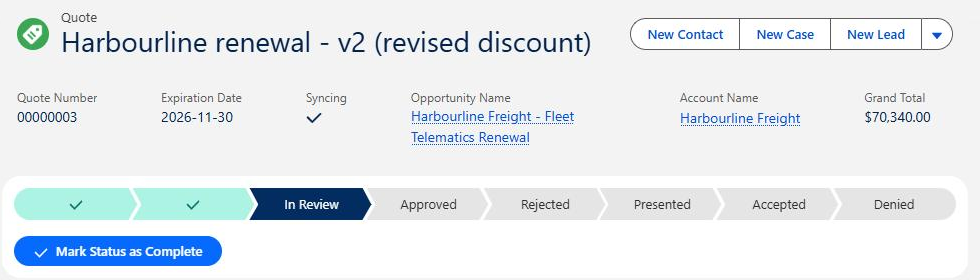
Screenshot: the revised quote sits at In Review. A status value alone doesn't tell a manager who must act next or how long the quote has been waiting.
Discounts, margins and unusual terms need oversight. The cost appears when nobody can see where a quote is waiting, who decides next, or what happens when an approver is away. Measuring approval turnaround separates the controls you need from the delays you don't. Once terms are approved, a different risk begins: see our guide to keeping discount approvals valid when deal terms change.
2. Salespeople spend hours maintaining quote lines
A sales operations practitioner in r/salesforce (April 2025) described their team spending "a ton of time" on line-by-line quantity and pricing updates in Salesforce CPQ, sometimes 500 lines or more. A reseller answering government RFQs wrote in r/SaaS (June 2025) that reps spent half the day working on PDF line items and Salesforce fields.
Repetitive editing consumes skilled time, every manual change is a chance for an error, and knowledge concentrates in the one or two people who can maintain complicated quotes. Bulk updates or automation can help, but only after someone confirms how pricing and calculations should behave. No tool, including AI, should change complex commercial pricing without that validation.
3. Pricing complexity exceeds the current workflow
A RevOps practitioner in r/revops (June 2026) described pairing Word templates with standard Salesforce Quotes to handle multiyear agreements with annual increases, tiered pricing and prorated subscription terms. There had been internal opposition to investing in CPQ, and because quote volume was relatively low, the workaround was tolerable but frustrating.
Workarounds survive because replacements look disproportionately expensive, yet every multiyear or prorated quote relies on someone getting the arithmetic and terms right outside the system. Start by documenting the pricing rules you actually use and how often they occur. Not every growing company needs CPQ.
4. Quote revisions create document confusion
A services business in r/salesforce (August 2025) described creating estimates, copying them into statements of work and producing multiple copies before sending. Staffing requirements made this more complex than pricing a product, and they saw some CPQ tools as overengineered.
Every copy is another place where a price, scope or date can drift. When the customer asks for a revision, someone must update each version, and the customer may still receive one that disagrees with the others. A single controlled source for commercial data, with clear ownership of each document, removes much of that risk.
5. Quote information does not reliably reach downstream processes
A quote's products and prices feed the Opportunity and, later, an order, contract, invoice or project plan. Salesforce sync keeps line items aligned between a synced quote and its Opportunity, and replacing the synced quote replaces the Opportunity's line items. But if the wrong quote is synced, syncing stops, or final terms live only in a Word document, downstream records can disagree with what the customer accepted. Every manual re-entry is a handoff that can fail. If quotes feed a finance system, review these common Salesforce ERP integration mistakes.
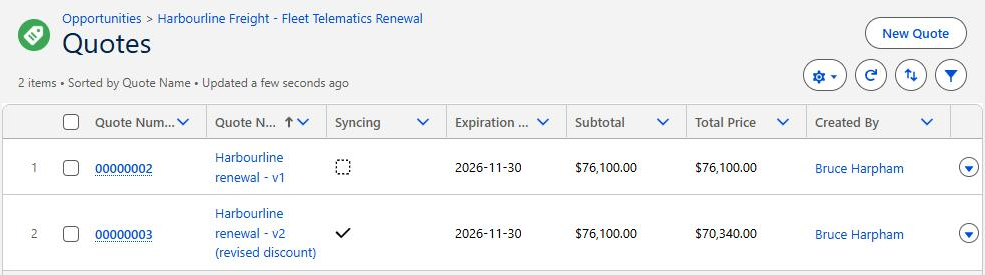
Screenshot: two versions of the same renewal quote on one Opportunity. Only v2 is syncing; v1 remains a separate version at the original $76,100.
How Can Managers Identify the Biggest Quoting Bottlenecks?
Start by measuring. Salesforce does not report most of these automatically; some need custom fields or report changes, others a short manual sample. A few weeks of recent quotes is often enough to see a pattern.
| Symptom | Business consequence | First diagnostic question |
|---|---|---|
| Quotes take days to reach a first draft | Customer momentum fades | How long from request to first draft, and what is it waiting for? |
| Quotes sit in approval | Revenue timing slips; reps chase decisions | What is the typical approval turnaround, and who is the backup approver? |
| Approved quotes aren't sent promptly | The buyer waits after the hard part is done | How long from approval to customer delivery? |
| Many revisions per deal | Rework and inconsistent terms | How many versions does a typical quote go through, and why? |
| Quotes corrected after review | Error exposure and credibility risk | What share of quotes needs correction before or after sending? |
| Heavy line-by-line editing | Skilled time spent on administration | Which edits are repeated across quotes? |
| Quote data re-keyed downstream | Order, invoice or delivery mismatches | What share of won quotes is re-entered in another system? |
These are proposed management measures, not standard Salesforce metrics.
Improve the Quoting Process Before Buying More Software
- Map the actual process. Follow three or four recent quotes from request to delivery, including Slack messages, spreadsheets and documents outside Salesforce.
- Find unnecessary handoffs and duplicate entry. Note every point where information is retyped or copied.
- Standardize product and pricing information. Clean up Price Books and products so reps aren't improvising.
- Clarify approval responsibility. Define who approves what, expected turnaround, backups and escalation.
- Improve document generation and version control. Use templates fed by Salesforce data and decide which version is authoritative.
- Measure again. Repeat the same measures so you know what improved.
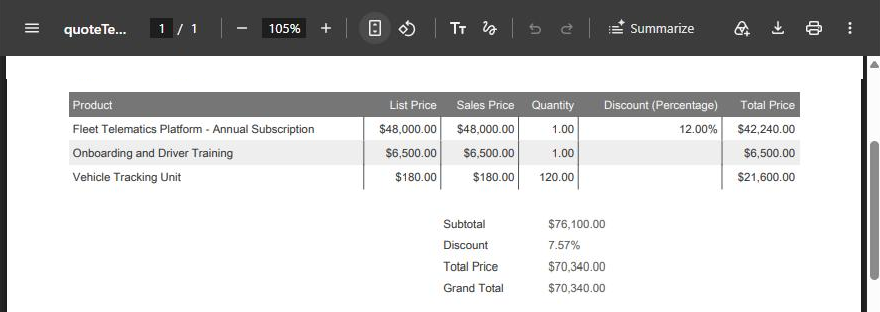
Screenshot: a quote PDF generated from Salesforce's standard template, with line items, the discount and totals pulled from the quote record (sender details cropped out).
An escalation rule, a cleaner Price Book or a better template can shorten the cycle without a major implementation. Results vary, so measure rather than assume.
When Are Standard Quotes No Longer Enough?
Sometimes the process is sound but the tool can't keep up. Salesforce CPQ, Revenue Cloud or another quoting platform may merit evaluation when you regularly face:
- complex product configurations, bundles or dependencies
- contract term calculations such as proration, ramps or annual increases
- large quotes that are revised frequently
- multiple pricing models, such as tiered, subscription and one-time charges
- renewals and amendments that must reflect the original contract
- quote volumes where manual workarounds no longer scale
- a requirement to turn accepted quotes into orders and contracts reliably
Base the decision on documented requirements and total cost of ownership: licences, implementation, administration and training. The r/revops example shows why: at low volume, a frustrating workaround can still cost less than a platform. Product names, licensing and capabilities change, so confirm them with Salesforce before deciding.
When Should You Bring in a Salesforce Consultant?
Outside help is most useful when the problem crosses teams, nobody has time to map it, or you want an objective view before buying software. A consultant can:
- map your current quote process and measure where time goes
- audit quote, Price Book, product, template and approval configuration
- identify sources of manual work and duplicate entry
- improve approvals, handoffs and document generation
- review pricing and quote data quality
- implement proportionate improvements in your existing org
- help you judge whether CPQ or Revenue Cloud is justified
If fixes like these keep waiting for an owner, Logic Conduit's Salesforce managed services provide a bounded monthly pool of admin and developer hours.
Next Steps
Are slow or error-prone quotes making it harder to close business?
Logic Conduit can help review your Salesforce quoting process, identify unnecessary handoffs and develop practical improvements that fit your business.
Contact Logic Conduit to discuss your quote management challenges.