Salesforce Managed Services Consulting: When Is a Monthly Retainer Worth It?
Small Salesforce requests can hold up important work: a report needs correcting before the forecast meeting, a new employee needs access, or a workflow has stopped passing information to the next person. Someone has to investigate, make the change and check the result.
Salesforce managed services consulting is an ongoing arrangement for agreed Salesforce administration, development and advice. A monthly retainer can make sense when useful work recurs and your business needs additional capacity, specialist skills or continuity. It can support an existing internal admin or developer, with your business retaining ownership of priorities and acceptance.
A retainer can also be the wrong purchase. A major implementation needs a delivery plan; sustained daily demand may justify an internal hire. If your team has not agreed how a process should work, settle that before automating it.
These ten questions draw on public Salesforce discussions from 2021–2026. The accounts are self-reported, not a representative survey or Logic Conduit testimonials. Our recommendations address the concerns raised; historical prices and allegations are not treated as established facts.
1. What if we already have an internal Salesforce admin or developer?
A buyer asking about managed services in November 2021 wanted to know whether the arrangement was cost-effective compared with an employee. The replies described both useful ongoing relationships and concerns about business knowledge and consultant turnover.
An internal Salesforce admin or developer does not eliminate the case for managed services. Does your team have the time, skills and dependable cover for the work your business requires?
Your internal person brings business knowledge: they can explain requirements, challenge recommendations and confirm that changes work. Outside support can protect their time for work that needs that context.
Ten licenses and 200 licenses can mean very different workloads
Consider two illustrative scenarios, not staffing benchmarks:
- A 10-license organization with a straightforward setup: one suitably skilled internal resource may be able to handle the routine work, provided the workload is manageable and there is a plan for absence or unfamiliar tasks. A monthly external commitment might add little value.
- A 200-license organization running sales and customer service: the team may be managing cases, internal service targets, customer service-level commitments, reporting, automation and connected systems. One internal admin or developer might spend most available time keeping daily work moving, leaving development and preventive work waiting.
License count is a clue to investigate, not a rule for deciding headcount or buying a retainer. A small org with complex integrations can need specialist help; a larger org with an adequately staffed team may need little recurring outside support. Salesforce's administration guidance identifies implementation complexity and request volume as staffing factors alongside business size.
What could an external team add?
Name the work external capacity would make possible:
- Integration development and improvement: investigate repeated data entry, repair an agreed connection or develop a defined handoff that reduces copying and reconciliation. An admin's role does not automatically include custom integration development; an internal developer may have that expertise but lack spare capacity.
- Platform-change readiness: Salesforce has three seasonal releases each year. Assign time to review relevant changes, identify affected workflows and plan checks. Salesforce's sandbox-preview guidance explains how teams can evaluate features in their own configuration ahead of production release. An external provider can take on agreed review and testing work alongside the internal owner.
- A separate improvement workstream: give recurring fixes and scoped enhancements a place in the plan while the internal person handles daily questions and business decisions.
- Specialist review and continuity: arrange a second person who understands critical work, can review unfamiliar changes and has an agreed handover process.
These are capabilities to confirm with the provider. A monthly hours pool does not automatically include every integration, cloud product, release task or incident. A new integration or substantial redevelopment may need a separately scoped project; maintaining an existing connection may fit the monthly agreement.
For example, in the hypothetical 200-license org, the internal admin could own priorities, user relationships and acceptance. The external provider could investigate a manual accounting handoff and complete agreed release checks. The business would still need to approve the integration scope, arrange participation from the accounting-system owner and decide who handles failures.
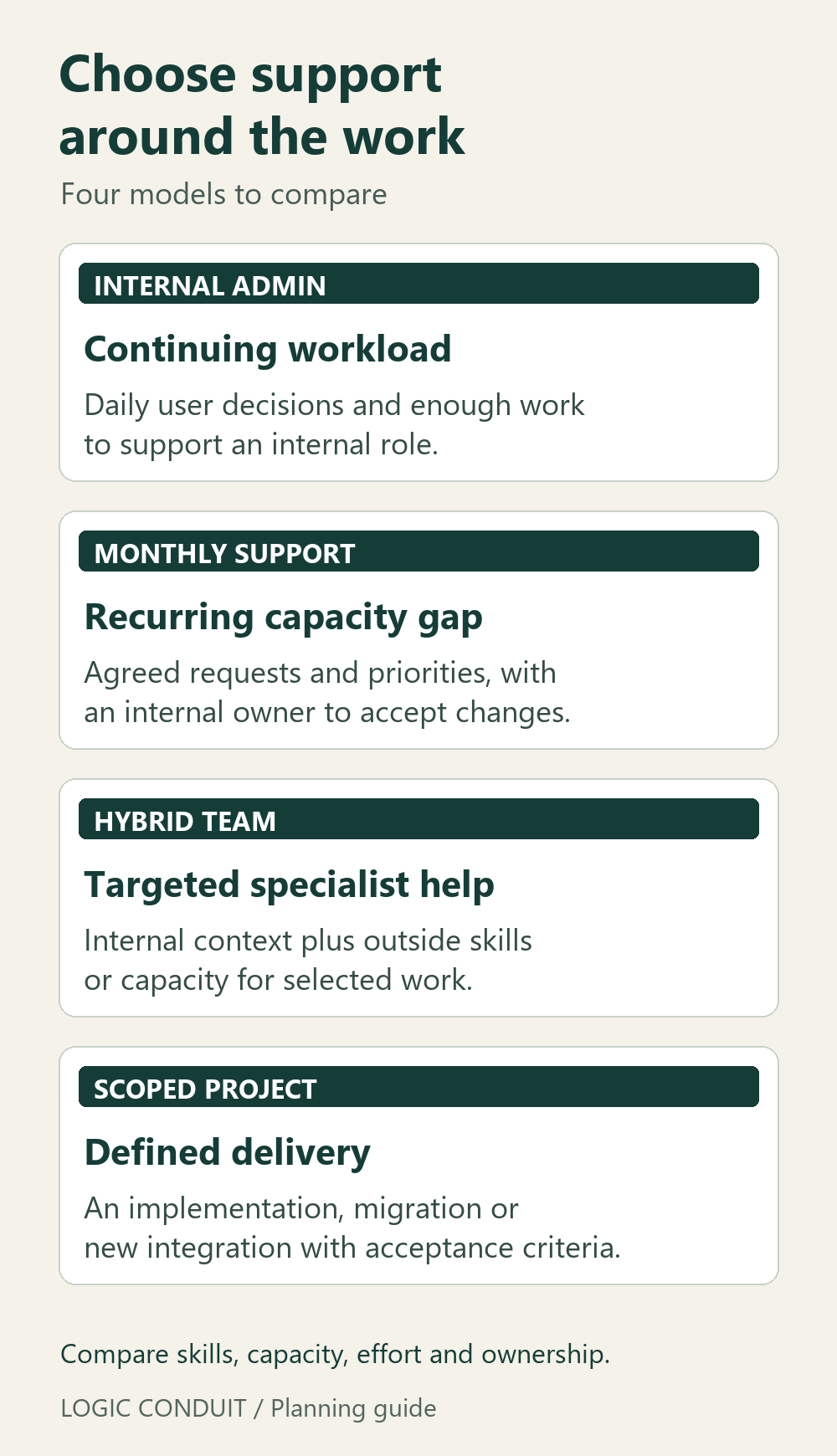
Compare each option against the same workload:
| Your situation | Starting point to evaluate | What to establish |
|---|---|---|
| A substantial, continuing workload and frequent user decisions | Internal administrator, with specialist help where needed | Enough work, budget and management support for the role |
| Recurring requests that exceed available internal capacity | Monthly support | Skills, usable capacity, response expectations and a business owner |
| An internal admin or developer with competing operational and improvement demands | Hybrid arrangement, potentially with recurring external capacity | Which tasks stay internal, which skills or hours are missing, and who owns each handoff |
| A defined implementation, migration or new integration | Separately scoped project | Deliverables, dependencies, milestones and acceptance |
| An occasional isolated request | Ad hoc engagement | Availability, minimum charges and enough context to do the work safely |
Include internal coordination, testing and decisions alongside external fees. A lower invoice is less persuasive if your operations manager spends every Friday explaining the same problem again.
2. Why are we paying again for small changes after implementation?
In an October 2022 discussion, a customer said most implementation work had been delivered, but remaining usability changes affected essential sales functions. They accepted that additional scope could cost more while questioning the new estimates.
Before moving those requests into a monthly retainer, sort them into three groups:
- An agreed requirement that does not work: review the original acceptance criteria and correction terms with the implementation provider.
- A new or changed requirement: assess its business purpose, dependencies and delivery scope.
- Recurring improvement or maintenance: decide whether the continuing workload justifies monthly capacity.
A retainer should not obscure a dispute about whether already purchased work was delivered.
For each request, write what the user cannot do, the expected behavior and how you will confirm the result. “Fix Salesforce” gives neither party a useful basis for planning.
3. How can we tell whether the hours and estimates are reasonable?
In an August 2024 discussion of support after go-live, a customer-side commenter said distrust of estimates contributed to keeping work internally. The disputed estimate was not independently assessed.
Ask what an estimate includes: investigation, business clarification, configuration or development, testing, deployment and documentation. Then ask which uncertainty could change it.
Here is a fictional planning example, not a Logic Conduit quote or a promised delivery rate:
| Use of a hypothetical 20-hour monthly pool | Hours |
|---|---|
| Understand the inherited setup and agree the change | 4 |
| Make the agreed changes | 8 |
| Test the affected workflow and support acceptance | 4 |
| Document the result and hand it over | 2 |
| Review priorities and progress | 2 |
| Total | 20 |
An inherited setup might need more investigation than this example; a familiar report change might need less.
Agree how estimates are approved, what happens when an investigation reaches its limit, and who can authorize additional work. Also settle minimum billing increments, unused hours, overages and whether meetings consume the pool. Confirm these terms before signing.
4. Will we get documentation we can actually use?
An internal administrator writing in October 2024 said promised documentation had not arrived after more than six months. Earlier decisions were difficult to reconstruct, and the division of responsibility with the agency was unclear.
Include a brief handover with accepted changes:
- The business purpose and the person who approved it.
- What changed and which other processes depend on it.
- The checks performed, the observed results and unresolved exceptions.
- Where the current configuration or code is recorded.
- What the next maintainer needs to know before changing it again.
Store the material somewhere your business can access and maintain. Ask a colleague to use it to explain the change; a folder full of files is not the same as a usable handover.
Documentation takes time. Budget it alongside delivery, and decide which existing gaps matter most. Our guide to Salesforce Flow continuity explores the related problem of critical automation depending on one person.
5. Why can a seemingly small repair take weeks?
In a May 2023 account of an admin–consultant relationship, an internal admin reported a long approval route for a monitoring-permission repair. They also acknowledged making a separate report deletion without following the required change process.
A change that looks small can have dependencies. The buyer still needs a comprehensible route from request to delivery.
Agree separate expectations for:
- Acknowledgment: when someone confirms receipt.
- Assessment: when the issue is understood well enough to recommend a next step.
- Scheduling and approval: who authorizes work and when it can proceed.
- Delivery and acceptance: when the change is released and checked.
A quick response does not promise a quick resolution. Monthly hours also do not automatically reserve an emergency team. If your business needs evening incident cover, weekend availability or a guaranteed service level, make that requirement explicit before comparing offers.
6. Can support bridge an administrator's departure?
A June 2022 poster described being left to learn Salesforce administration after the company's knowledgeable employee quit. The post provides little operational detail.
Outside help can bridge recruitment, training or redistributed responsibilities. Agree what comes next.
Start with the workflows whose interruption would affect customers, sales operations or management decisions. Identify authorized access, important deadlines, known failures and who can approve work. Agree what the external person will investigate before making changes.
Then decide what should be handed to an internal owner, what needs continuing specialist support and what can wait. If the initial problem is an unknown inherited setup, a bounded assessment may be the more useful first purchase.
Avoid replacing one undocumented dependency with another. Record decisions as the work proceeds and establish what happens if the assigned external person becomes unavailable.
7. Could we train an existing employee instead?
In an April 2025 nonprofit discussion, a nontechnical employee said management wanted two staff members to train as an architect and an administrator so it could stop paying consultants. They were trying to understand the time and cost involved.
Assess the responsibilities the employee will take on, their time to learn and who will review unfamiliar work.
List the tasks: managing access, maintaining reports, understanding automation, investigating failures or designing larger changes. Decide which the employee can own now, which need supervised practice and which should remain with an experienced specialist.
An exam result alone does not show that a person can safely maintain your particular setup. Equally, an internal employee with relevant experience should not have to outsource routine tasks indefinitely.
A hybrid arrangement can provide transition support and review while internal capability grows. Reassess the outside hours as that capability changes; do not assume last year's allocation remains appropriate.
8. Are we buying advice, or just getting requests completed?
A March 2026 discussion describes a staff member struggling to obtain understandable explanations for design decisions and training estimates. The allegations were not independently verified, but the demand for explanations is a reasonable buying concern.
Consulting should help you decide what is worth changing. Ask the person proposing work to explain:
- The business problem and the evidence available.
- The options, including a process change or leaving the system alone.
- The important dependencies and trade-offs.
- How the business will judge the result.
For example, a request for another mandatory field deserves a discussion about who supplies the information, when it becomes known and what happens if it is missing. Completing the field request does not settle those questions.
If nobody can explain the existing setup, start by investigating it. If the proposed repair keeps expanding, pause and compare that work with a separately scoped redesign. Our Salesforce technical debt guide addresses that decision.
9. How much work will our own team still have to do?
An internal administrator considering a Service Cloud project in January 2024 had the skills to do the work but lacked capacity. They compared full-service and hybrid options while trying to limit their own weekly involvement. The same capacity question applies to recurring support.
Write down what your business retains: setting priorities, explaining requirements, making policy decisions, arranging access and checking whether changes work for users.
For each task, name both the delivery owner and the person who accepts the result. A report change might require a manager to agree definitions and reconcile a sample. A handoff change might require sales and operations to agree which team owns the next step.
Estimate your team's involvement alongside the provider's hours. If nobody internally can answer questions or test the result, address that constraint before buying more capacity.
10. Doesn't our Salesforce support plan already cover this?
An August 2024 buyer question asked whether Salesforce Success Plans would manage integrations with third-party applications.
Check the task against your actual entitlements. Salesforce describes its Success Plans as combinations of resources, guidance and support, with different levels and product coverage.
The current Core Developer Support guidance, published October 28, 2026, excludes work such as creating code, troubleshooting third-party applications, and building or redesigning flows or their custom logic. That is a boundary of that support offering, not a claim that Salesforce never provides hands-on delivery through other services.
Identify who will investigate a product issue, implement a business change and operate each connected system. If your need is a new integration, define its delivery scope separately; our Salesforce integration-services guide explains what to include.
Make the first month a decision you can evaluate
Before committing to ongoing support, write a one-page brief with your three most important requests, their business consequences, the internal owner and what would count as a useful result.
Agree a review point and a small set of measures:
- Which agreed changes were accepted and which remain blocked.
- Time consumed by investigation, delivery, testing and handover.
- The age and business impact of important unresolved requests.
- Recurring problems that returned after an attempted repair.
- Whether the internal owner can find and explain the work delivered.
Closing many easy tickets does not settle a critical unresolved problem. An investigation that prevents an unnecessary build can still be useful. Track staff time released separately from actual cash savings, and label estimates as estimates.
Use the monthly Salesforce support decision worksheet to prepare that discussion.
Discuss the work that keeps coming back
If your team has recurring Salesforce work but no reliable capacity to move it forward, explore Logic Conduit's monthly Salesforce support.
The service provides a defined monthly pool of admin and developer hours, with scope, priorities, working hours and terms agreed before work starts. It does not include 24/7 monitoring or emergency coverage. Major implementations, migrations and new integrations need separate assessment and scope.
Tell Logic Conduit your two most pressing Salesforce problems, who handles them today and any deadline that matters. We can discuss whether the useful starting point is monthly support, a focused assessment or a separately scoped project.